Brandy Nālani McDougall recently took part in the W.S. Merwin Maui Conservancy Green Room Series. Led by U.S. Poet Laureate Joy Harjo and six other Pacific Islander poets, the event celebrated National Poetry Month. McDougall is now an established author who has deep Maui roots: originally from Kula, she graduated from Kalama Intermediate School in Makawao, and later Kamehameha Schools. Her most recent book, ‘Finding Meaning: Kaona and Contemporary Hawaiian Literature’ is the first extensive study of contemporary Hawaiian literature. It recently won the Beatrice Medicine Award for Scholarship in American Studies. Currently, McDougall is a University of Hawaii associate professor of Indigenous American Studies.
“In ‘Finding Meaning’, I examined a selection of fiction, poetry and drama by emerging and established Hawaiian authors,” McDougall said. “At the center of the analysis is kaona, the reference to a person, place or thing in a common experience and the intellectual practice of finding meaning that encompasses the symbolic and the figurative. I interpreted examples of kaona, by guiding readers through olelo no’eau (proverbs); mo’olelo (literature and histories); and mo’okū’auhau (genealogies). Kaona and indigenous stories connect the past to the present by unveiling complex layers of Hawaiian identity, culture, history, and ecology.”
Aside from her scholarship and poetry, McDougall is the co-founder of Ala Press, an independent press dedicated to publishing creative works by indigenous Pacific islanders. In addition, she currently serves on the board of managing editors of the American Quarterly, as well as the board of the Pacific Writers’ Connection. Her current research focuses on the aesthetics of indigenous women’s activist fashion within land and water protection movements.
“I am researching the role of visual arts in Hawaiian culture in addition to literature and theater,” McDougall explained. “Fashion in land and water movements plays a vital role in making a meaningful statement. For example, silk-screen t-shirts, hand-made printed shawls and other items made in Hawaii, make a difference. Fashion is sometimes seen as superficial; however, it puts Hawaiian women in the place of being educators in the community. Fashion is a way of carrying an important message about the āina.”
Understanding kaona in Hawaiian literature is a journey to find meaning in the lives of others, as well as the commonalities we share as humans in different cultures.
Brandy Nālani McDougall, University of Hawaii Associate Professor, Indigenous American Studies
Loren Lapow, founder and director of the Maui Hero Project (MHP), Inc., believes that everyone has a hero or heroine within. With a master’s degree in social work, Lapow founded MHP in 2000 and has been coaching adults, youth, families, and communities ever since. Using evidenced-based techniques and his exceptional capacity to guide people through life crises, he has helped thousands to transform their lives.
“We are all on a journey in life,” Lapow noted. “We can all learn how to take control and create positivity in our lives as well as to serve others. In fact, the main skill participants come away with is to be the person who steps up when something happens, to be more confident in taking the leadership role while others might not.”
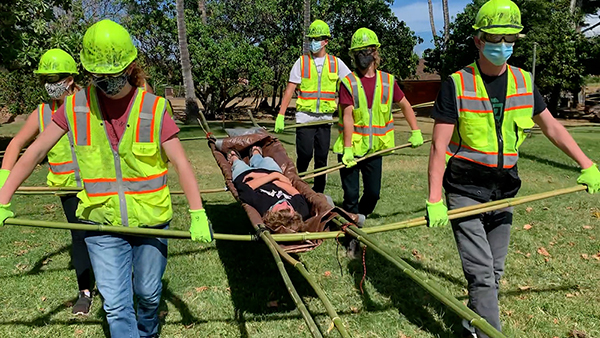
Lapow integrated the Teen CERT (Community Emergency Response Team) Program with the Hero Project to create a Hawaiian-style disaster preparedness course. Meeting at the Paia Youth & Cultural Center, students in the program undertake 100 hours of training that follows the national CERT curriculum. “The students amaze me by how much they care about each other and the community they are part of,” Lapow said. “I think they find strength in the way they act as a team.”
The Teen CERT program fuses disaster-preparedness training with Maui cultural stories, then adds in the adventure, search and rescue components. By re-tracing the Maui myths, youth are experientially taught core skills, as well as appreciation for Hawaiian culture. Some graduates of the program bring their training when they join the new HEROEZ Junior Red Cross Club also housed at the youth center.
Program graduate Elizabeth Clark said, “I still reflect on and learn from my experiences with MHP. Lapow inspired me to go into human services to work with youth in the future.” Maui author Toby Neal added, “Lapow is a motivating communicator who forges new and unique connections among diverse groups of people in a way I have seldom seen done in social work. He teaches his students to have confidence in themselves and how to provide help in the community.”
Our mission throughout the global pandemic is to help youth find connection despite distance, through acts of service to their community and everyday heroism.
Loren Lapow, Maui Hero Project, founder and director
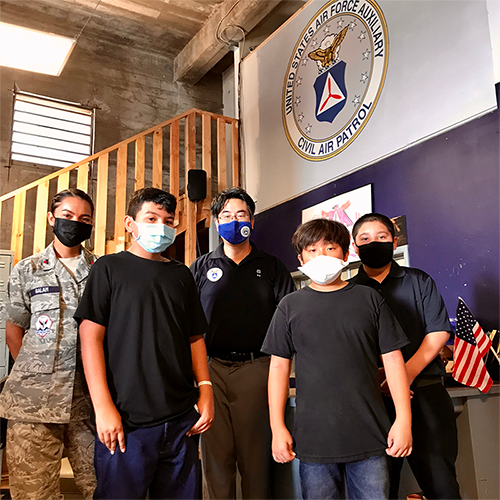
The Civil Air Patrol (CAP) Maui County Composite Squadron 057 is celebrating its 46th year of serving Maui County. The nonprofit organization is tasked by the U.S. Congress to help run programs that keep the country at the forefront of advanced air and space technology. With their adult and youth development program, CAP’s mission, to ‘Empower members with opportunities and resources to promote aerospace-related STEM (science, technology, engineering, mathematics) education and careers’, provides all Maui residents with numerous ways to serve the community.
As the civilian auxiliary of the Air Force, cadets develop ethical leadership skills, embrace an active fitness lifestyle, and gain problem-solving techniques through character development lessons. “Today’s cadets are tomorrow’s leaders,” said Col. Chantal Lonergan, CAP Hawaii Wing Commander. “They are committed to a personal code of honor, and are ready to lead in a diverse society. A capstone of the cadet experience is in our Orientation Flight Program where cadets receive education and training in preparation for flight in gliders and powered Cessna aircraft. For cadets who are motivated, there is an opportunity to apply for various scholarships for flight academics and special CAP activities. CAP’s STEM education programs bring over 40 free fun and engaging products and programs to our members in squadrons and classrooms throughout Maui. The program’s motto describes what cadet flying is all about: ‘Safe, fun, educational’.”
Cadet Lexie Galam added, “We are learning basic laws of physics and how they apply to aircraft and flying. Pilots explain how to perform basic flight maneuvers and the manner in which control surfaces are manipulated during roll, pitch, and yaw. For example, we learned about climbing turns with an emphasis on collision avoidance; how shallow climbs and descents affect vertical velocity and airspeed indicators; turns using magnetic compass and possible compass turning errors—variation, deviation, magnetic dip, and oscillation error; medium and steep bank turns; and how proper rudder coordination and control stick requirements keep the nose up. Volunteer services with CAP allow us to do good for other people. Even as kids, we can make a difference.”
Serving adults and youth in pre-K-12 grades, we offer aerospace courses and teacher training to increase comprehension of and enthusiasm for STEM topics.
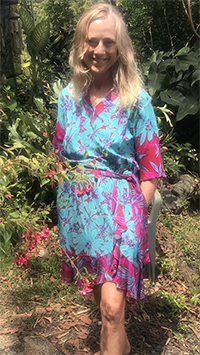
Rainbow Jo, a dynamic upcountry clothing company, offers original artwork on clothing by Maui resident and designer Michele Joy Thornton. Since 1986, Thornton has served wholesale and retail customers throughout Hawaii and beyond with innovative and updated resort wear. Headquartered in Makawao, with a factory in Indonesia and her own building with a retail store and an Airbnb in historic downtown Hilo on the Big Island, Thornton manages both her Hawaii and overseas production staff.
Creating all of her own fabrics, Thornton’s designs and colors are complex, with each design requiring seven different screens for the process. She works out the color theories, doing the print designs and working with silk screeners to turn her artistic ideas into technically perfect realities.
“At Rainbow Jo, all of my original artwork is hand silk-screened onto natural fiber rayon clothing and steam set, using no chemicals to set the dye,” Thornton explained. “Plus, the highest quality French seams are used to ensure that the clothing from Rainbow Jo is always perfectly made and easy to care for. The ideas for my prints are inspired by nature and Maui’s beauty. I believe the continued successful growth of the company comes from my strong retail background, and my love of color and design.”
Thornton started selling clothing at age 16 and through the years her work led her to Hawaii. In 1982 she received a degree in marketing from Indiana University School of Business and after years of working in the clothing industry she was ready to begin her own venture.
Thornton reflected, “My ambition was to own my own business and Maui was the perfect location. Currently, the pandemic has changed normal business routines. At Rainbow Jo we have stayed resilient with an online business and now many of our island-wide retail stores have re-opened. My plan is to stay flexible enough to know when to make changes and follow new trends and procedures. My hope is that careful planning and the hard work that built Rainbow Jo will see us through the Covid crisis. Persistence and resilience are everything!”
We feel blessed at Rainbow Jo to be resilient in an economic climate that has hit small businesses hard.
Michele Joy Thornton, Rainbow Jo, owner and designer
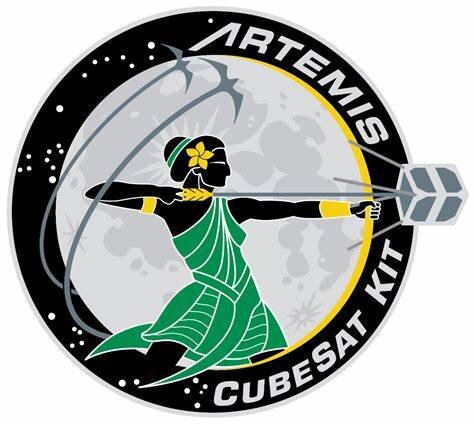
Maui Economic Development Board’s (MEDB) STEMworks™ Solutions program brings month-long industry-based challenges to 7th-12th grade STEMworks students. The participants use STEM (science, technology, engineering, mathematics) tools and the entrepreneurial mindset to develop innovative solutions for real problems. During the February 2021 challenge, Hawaii students learned about NASA’s Artemis Program to return us to the Moon, and cubesats from experts at the Hawaii Space Flight Laboratory (HSFL). The second challenge was to create an Artemis mission patch design. “We are so proud of all of the submissions we received,” said Katie Taladay, STEMworks Program Manager. “The selection for the best mission patch design award went to Jadynne Zane, MJ Dinong, Jenna Payba, and Erinrose Salacup of Maui High School. The team featured a simple design that incorporated the moon as the bow and the line in the A of Artemis as the arrow. We will print this design on a patch for all participants who completed the challenge.”
The HSFL payload design winner was “Exploring the Potential of Solar Winds as a Power Source” by Jalen Matsuda Williams, Derek Takeno, and Justin Paul Alejo, also from Maui High. In addition to a $500 prize, this team will have a chance to work with a real Artemis CubeSat kit to bring their idea to life under the guidance of HSFL scientists during the MEDB STEMworks Summer Internship.
“Our team used the cubesat to determine the viability of a new power source on a lunar base, using solar winds,” said Williams. “This will help NASA’s Artemis mission to determine and investigate the viability of a Dyson-Harrop Satellite (DHS) as a power source. The DHS has a wire at the end of the satellite which points at the sun and creates a cylindrical magnetic field. The charged wire can divert electrons from the initially charged plasma, which then get funneled into a metal sphere receiver, and creates an electric current. With this is mind, our satellite will give the mission valuable information, possibly enabling astronauts to have an abundance of energy that can be used to power a lunar base outpost, space vehicles, and more.”
We appreciate the opportunity from MEDB to share our research with the STEMworks students. Inspiring the next generation and building Hawaii’s aerospace workforce is so important for diversifying Hawaii’s economy.
Amber Imai-Hong, HSFL Avionics Engineer and Outreach Specialist