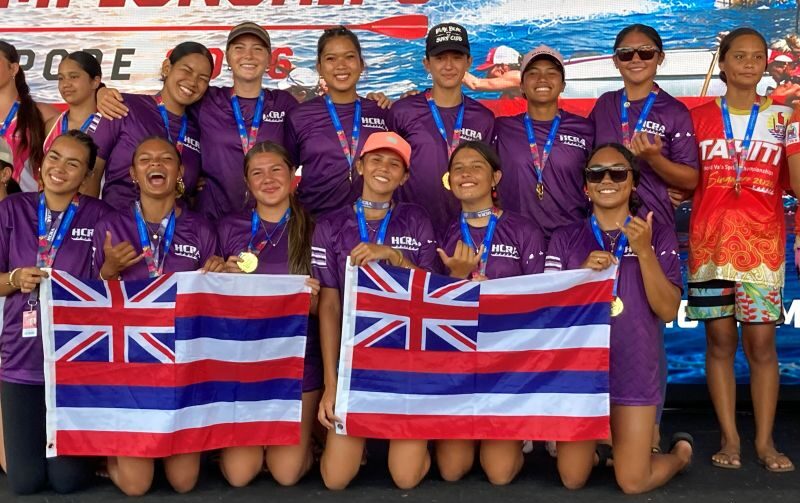
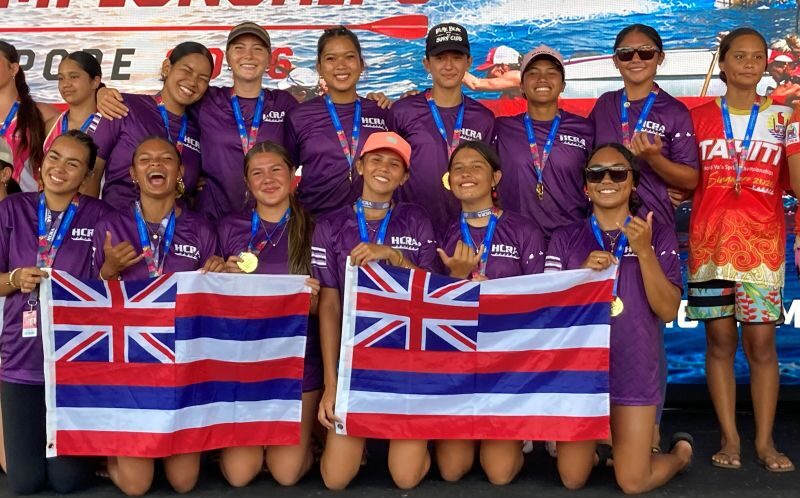
Hawaiian Canoe Club on Maui was proud to have so many of their paddlers, ages 14-80, representing Hawai‘i at the 2026 International Va’a Federation World Sprint Championship in Marina Bay, Singapore. Paddlers, keiki, and kūpuna traveled over 6,000 miles to compete on the international stage, where Hawai‘i placed second in the world after Tahiti. Competitors from all islands participated across multiple international divisions, securing strong finishes. This year, the event included nearly 600 races, from one-man to double-hull, junior to over 80, as well as para va’a events, designed for athletes with physical impairments.
Approximately 470 competitors from Hawai‘i were in Singapore for 10 days, more than from most countries. “Hawai‘i was well represented—racing, cheering, helping one another, making new friends, and sharing plenty aloha along the way,” said Lisa Cano, long-time Hawaiian Canoe Club member. “At home, we may paddle for different clubs. We race against each other, cheer for our own colors, and spend our summers battling it out on the same regatta course. The way the clubs have responded during World Sprints says a lot about our sport. Club colors and competition matter, yet people have still been willing to share what they know and help paddlers from other clubs. That is aloha and ‘ohana in practice, helping one another so we can all move the sport forward.”
Cano enjoyed Singapore. She explained, “There was so much energy and so many other cultures to learn about. Plus, it was a tremendous honor to represent Hawai‘i. A beautiful thing about representing our state is that the International Federation recognizes Hawai‘i as its own country, so we had our Hawaiian flag flying over our tents where the crews sat together awaiting their turn. Also, our keiki did tremendous. They got the most points and secured the second-place world title for us. We are really proud of them!”
When asked what she loves about the Hawaiian Canoe Club, Cano added, “Sixty years ago, John and Kealoha Lake established the Hawaiian Canoe Club to preserve the art of outrigger canoe paddling through traditional Hawaiian values. We also have inspirational Youth Leadership and Scholarship Programs that encourage academic and personal growth opening up opportunities for future success.”
Our keiki come to the canoe club every day, they paddle, learn Hawaiian culture, language, and mele.
– Lisa Cano, Hawaiian Canoe Club
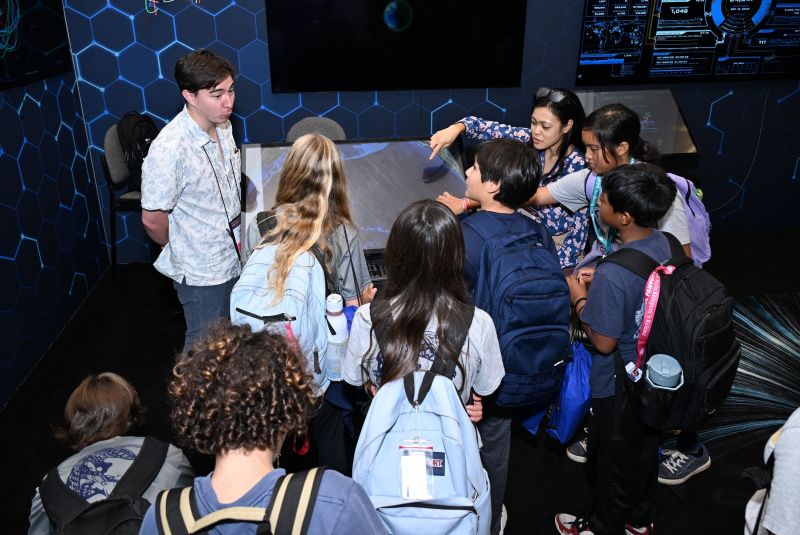
Student Space Exploration Day, one of many career awareness programs offered by STEMworks™ to Maui County students, welcomed middle and high schoolers to an exciting day of STEM-inspired (science, technology, engineering, mathematics) space events. Students enjoyed a special live presentation and talk story with astronaut Scott ‘Scooter’ Altman about living and working in space. They also experienced hands-on scientific demonstrations and presentations of advanced technologies by experts in the field.
Altman, a retired United States Navy Captain, talked about his four Space Shuttle missions as well as his time as a Naval aviator, test pilot, engineer, and astronaut. Recalling his initial rejection from the astronaut program, Altman inspired the keiki to never give up and to always keep trying, as he himself did.
“I like to engage with students because it’s important that we connect with the next generation and get them interested in space-related issues,” he said. “It will be students in this age group, whom I am talking to today, who might be the first ones on Mars!”
Lori Ann Koyama, Lāhainā Intermediate STEMworks Media Production and Graphics teacher, said, “My students were excited to meet the astronaut and to do the hands-on experiments. This day gets them thinking about future careers that are available to them and they always come away wanting more.”
Bernadette Detera, engineer, explained what she does. “We showed the students a 3-D visualization of over 34,000 objects in space which we track. We talked about what satellites contribute to our daily lives, for example, GPS navigation, weather prediction, and long-distance communication. These show the importance of humanity’s future in space.”
Anela Arakawa, 8th grade, Lāhainā Intermediate, noted, “I learned about all the different satellites and how they work and how many objects there are in space. It makes me want to know more, go to college, and get a law degree. Maybe I’ll work in Space Law!”
Jaysen Acoba, 8th grade, Maui Waena Intermediate School, added, “I’m interested in robotics and what it can do for our society in the future. It’s what I love about Student Space Exploration Day; it’s all so inspiring. I want to go to the Massachusetts Institute of Technology, a world-renowned research university, and help develop technologies that will create a safer space and a better world.”
Student Space Exploration Day really opens the students up to different opportunities they never even thought of. It is vital to get exposure like this for them. STEMworks makes it all happen!
– Lori Ann Koyama, Teacher, Lāhainā Intermediate School
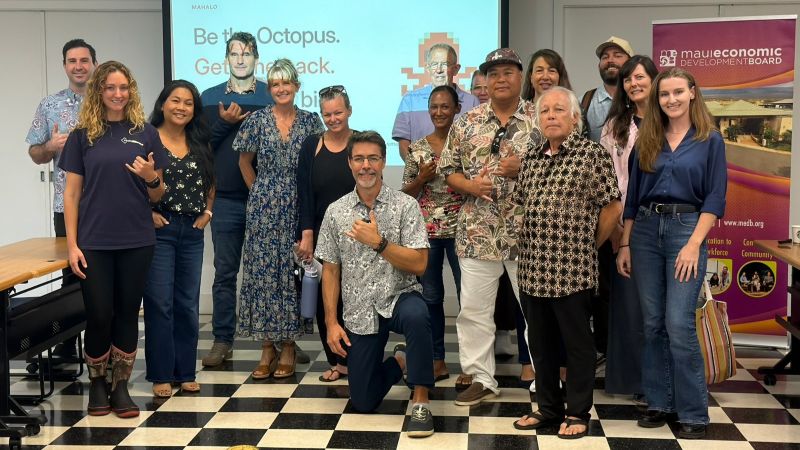
A group of small business owners and leaders of non-profits recently attended a workshop to grow their business with AI. The half-day workshop was hosted by Maui Economic Development Board (MEDB) and presented by Marc Rix, an international adviser, speaker, consultant, and trainer.
A Maui resident and serial small business founder, Marc has guided some of the world’s largest organizations through major technology shifts and helps business leaders put AI to work in practical, human-first ways.
“My goal was simple,” said Rix. “Help Maui’s business leaders separate AI myth from fact and apply AI in their organizations for fast, measurable results. Watching the room evolve from curious to confident to building real, working solutions before lunch proves that you can noticeably raise the tide on AI fluency on Maui in the right setting.”
Rix believes business leaders are being buried in AI noise, hype, and misinformation. The interactive workshop’s whole intent was to help them see through it and succeed with AI on their own terms.
Participants were asked to come prepared with a problem (or two) to solve. Rix helped them to build three “super skills” together, identify quick-win opportunities for AI in their own businesses, and had each leader build a working AI solution they took back to work that same day.
Wayne Wong, Director of Hawaii Small Business Development Center on Maui took part and said, “The workshop struck an unusually effective balance: enough AI understanding to build confidence, enough hands-on practice to make it tangible, and a strong connection to the everyday realities of running a small business.”
Dan Ellis, President of Pacific Millworks added, “We loved the delivery, engagement, and how we used our own business problems, not a textbook.”
MEDB runs workshops with support of County of Maui to assist small businesses owners and entrepreneurs. This workshop gave the confidence and practical skills to turn everyday challenges into working AI solutions—saving time and helping them focus on growing their businesses.
This workshop was not about AI hype, tooling, or engineering — It was about building business leaders’ AI intuition with practical, 80/20, people-first guidance.
– Marc Rix, Advisor, Speaker, Consultant
A cultural resource management nonprofit, ‘Āina Archaeology, has formed their practice to fulfill a kuleana (privilege and responsibility) to care for Hawai’i’s natural resources and cultural heritage. They serve individuals, communities, businesses, and government agencies to protect, preserve, and perpetuate Hawai’i’s ancestral assets by blending traditional Hawaiian land management techniques with contemporary methods of conservation. Tanya L. Lee-Greig, ‘Āina Archaeology Principal Investigator, said, “Our solutions leverage a project’s unique relationship with culture and sense of place. It’s an approach that provides more meaningful value for the client today, and a truer record of history for Hawai’i tomorrow. Our pioneering methodologies and firm commitment to our values enable us to implement creative solutions for all the community’s historic preservation needs.” Lee-Greig has nearly two decades of experience working in archaeology, anthropology, and cultural preservation. At ‘Āina Archaeology she assists with the selection, implementation and completion of projects they engage in. Traditional Hawaiian values are applied to achieve the collective goals of their clients and the communities they work with. Also partnering with community organizations, Lee-Greig offers hands-on archeological programs. Alongside regular job openings for field technicians and opportunities for students looking to break into indigenous archaeology, there are several structured internship programs, field schools, and organizational connections managed by ‘Āina Archaeology on Maui. Over the years, ‘Āina Archaeology has been a host company for Maui Economic Development Board’s (MEDB) STEMworks™ Internship program. During his six-week internship at ‘Āina, Tyler Taguchi did an in-depth analysis of the traditional Native Hawaiian diets of those in the rocky shoreline of Honua’ula. Taguchi shared, “This was my first long-term project. I learned so much about the history and culture of Honua’ula in Wailea and Makena. With my two mentors, I studied the trends between sea urchin and mollusk remains recovered from archeological sites in Honua’ula. We then presented the data of Native Hawaiians’ near-shore diets in a story-map format. Researching for this project taught me more about Maui’s history and culture. I’ve become more skilled in software like Excel and learned how to design and structure visual data. I would like to thank ‘Āina Archaeology and STEMworks™ for making my internship such an amazing experience.”
We share a deep expression, aloha ‘āina, love of the land, for our island, which feeds all aspects of our daily lives here.
– Tanya L. Lee-Greig, ‘Āina Archaeology, Principal Investigator
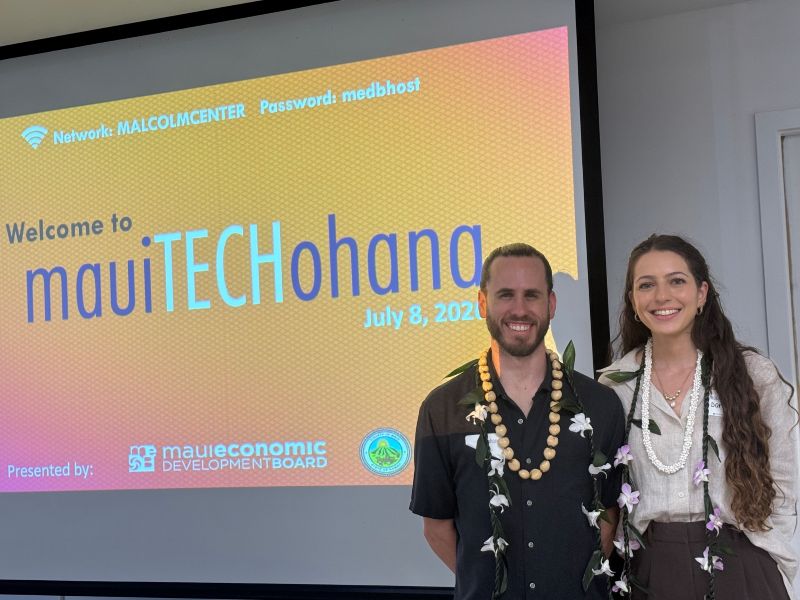
A mid-summer Maui TechOhana meeting, presented by Maui Economic Development Board (MEDB), explored how artificial intelligence (AI) is transforming the hotel guest experience and redefining hospitality. Husband-and-wife team Josh and Dana Ellis shared the story behind Abra Hospitality, their fast-growing AI guest intelligence platform. Josh, Abra’s CEO, brings years of management consulting and tech-industry experience. Dana, Abra’s Chief Hospitality Officer, is currently a manager at the Hotel Wailea with extensive personalized hospitality experience.
“Initially started to help Dana better organize her hotel job, Abra’s AI transforms scattered data into personalized, anticipatory service at scale, giving the hotel staff the superpower to deliver the moments that guests never forget,” Josh explained. “Abra unifies guest data, preferences, and staff observations into a single ‘living memory’ to help boutique hotels provide deeply personalized service.”Presented by MEBD and supported by the County of Maui, Maui Tech ‘Ohana offers a talk-story format and provides an informal networking opportunity open to anyone interested in Maui County’s technology sector.
Josh and Dana explored the power and potential of Hawai‘i’s growing tech ecosystem: how to tap into it, how AI is changing for entrepreneurs, and what fundamentals still matter most. “AI isn’t just the next wave of automation; it’s the operating logic of tomorrow’s enterprise,” Josh added. “Organizations that embrace it by 2028 will likely save costs, release products faster, and redeploy talent to higher-value work. Don’t be afraid of AI. In the long run, it’s here to actually give you more time for things that really matter to you.”
Melissa, a TechOhana attendee, shared, “I’m just beginning to incorporate AI into my business. Josh and Dana gave exceptional tips, from monitoring and feedback at early stages of AI development, to orchestration and strategic oversight as the capability advances. Maui TechOhana provides excellent assistance to businesses in the community.”
“It was a fascinating use of AI to improve the hospitality industry,” remarked Kevin Krewell, a retired technology analyst. “The goal was not to replace people but to enhance their capabilities to allow them to do a better job.”
“I think this should inspire other people looking to do startups in Hawai‘i,” Kevin added. “There’s a network of people within the whole Hawaiian chain – the idea that all of Hawai‘i should connect better as a technology island, a technology platform to share more back and forth between the various islands.”
Human roles will evolve significantly with AI. Enterprises that act early and approach autonomy as a phased transformation will secure lasting advantage and shape industry standards.
– Dana and Josh Ellis, Abra Hospitality
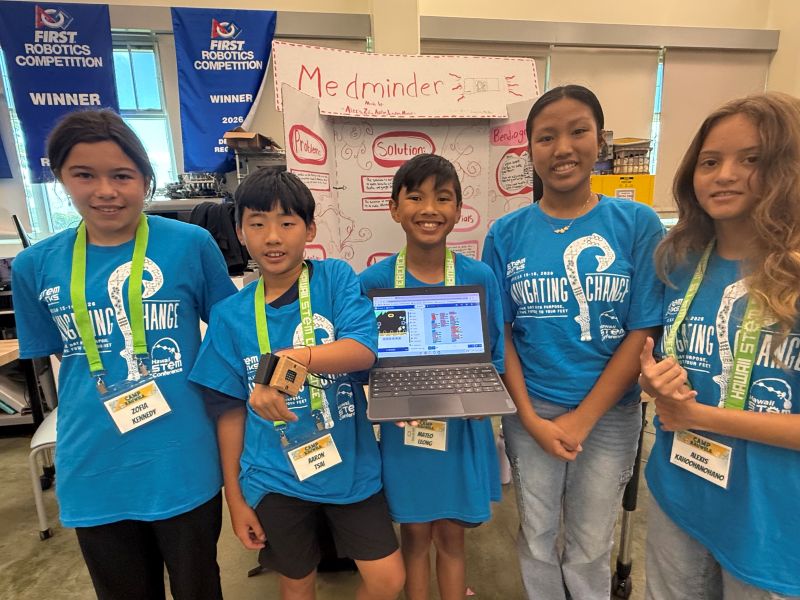
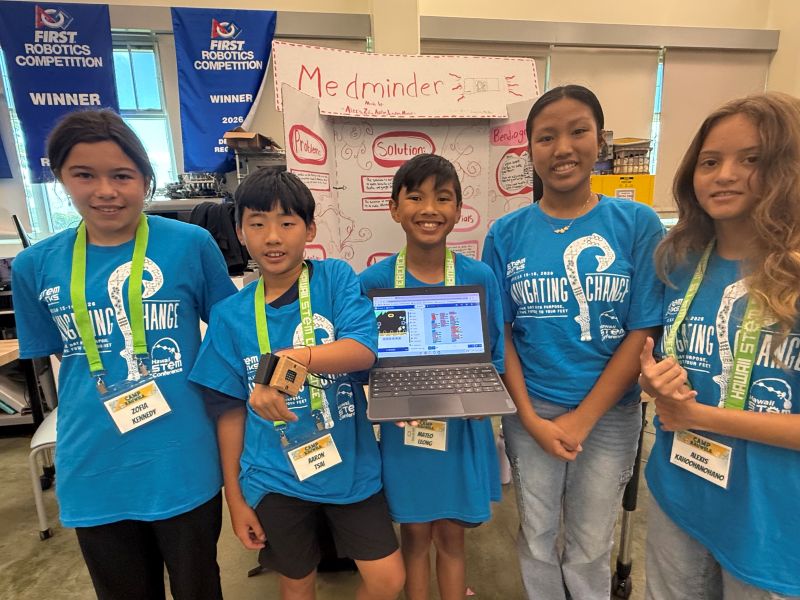
The Harrison and Helen Miyahira STEM Center at Maui High School recently hosted Maui Economic Development Board’s (MEDB) STEMworks™ Innovators Summer Camp program. Camp Kauwela, named after the Hawaiian word for summer, is a place for middle school students to learn, grow, and explore. It blends STEM (science, technology, engineering, mathematics) education with Hawaiian culture to inspire students to discover new ideas and potential career paths. Using 3-D printers and Microbit processors, 38 middle-school students and nine high-school STEM experts produced 14 Hawaiian-themed projects done over a period of five days, with a showcase held for families and friends on the last day.
“Camp Kauwela is based on scaffolding mentoring: a teaching method where a mentor breaks complex skills into smaller steps providing support until the mentee grows more confident while completing tasks above their current skill level,” explained Leslie Wilkins, MEDB President & CEO. “Together, the younger students are learning from the older students how to use these tools to improve our community.”
Lalaine Pasion, STEMworks Program Specialist, shared, “Camp Kauwela blends STEM education with Hawaiian culture to inspire students to look to the past to shape solutions to solve current challenges. Through hands-on learning, students developed skills, connected with local stories, and deepened their understanding of Hawai‘i’s land and people. More than anything, they left with a stronger sense of identity, heritage, and the power they have to make a difference, all while exploring how science and technology can help shape a better future for Maui.”
“I made life-long friends at Camp Kauwela,” said Alexis, one of the students. “Our Hawaiian word was Kupuna. We were able to express a deeper pride and understanding of our heritage as we worked on our project titled Medminder, a wrist device using Microbits to help kupuna remember to take their meds.”
Madison, in another group of participants, used a 3-D printer to make a ‘Charger Weight’. “Our Hawaiian word was Malama (to care),” she said. “Our team built a device to connect to phones that would solve the problem of chargers getting lost, falling or breaking. I also learned about different careers and how to work together on challenges and share creative solutions that can make an impact for our community. Thank you, MEDB!”
Mahalo to all our partners, volunteers, and supporters who made this year’s Camp Kauwela so special. More information about STEMworks can be found online at www.stemworkshawaii.org.
– Lalaine Pasion STEMworks Program Specialist
As part of the upcoming Ke Alahele Education Fund Benefit Dinner and Auction, the Maui Economic Development Board (MEDB) is inviting local students to apply for the 2026 Daniel K. Inouye Innovation Award. Established to honor the late U.S. Senator Daniel K. Inouye’s vision of Maui Nui as a center for innovation and technology, the award recognizes outstanding student projects that demonstrate creative and impactful applications of science, technology, engineering, and mathematics (STEM) to serve and strengthen the community. Projects may be completed through school coursework, clubs, internships, STEM programs, or independent study.
Applications are open to Maui County public school students in grades 6-12, as well as students who graduated from high school in 2026. Individual students and teams of up to five members may submit projects completed during the 2025-26 school year or Summer 2026. Applications must be submitted through MEDB’s online application portal by 11:59 p.m. on Monday, August 17, 2026.
As part of the application process, students will describe their project’s objectives, development process, STEM skills and tools utilized, project outcomes, and community impact. Applicants will also be asked to explain how their project addresses a community concern or provides a meaningful service to others. At least one photo of the completed project is required, and students may also submit supporting materials such as presentations, research papers, videos, and lab reports to strengthen their application. A bibliography or work cited is required with submission if applicable.
The recipient of the 2026 Daniel K. Inouye Innovation Award will be announced during the Ke Alahele Education Fund Benefit Dinner and Auction, where a cash prize will be presented. The award celebrates students who combine technical knowledge, creativity, and service learning to develop practical solutions to real-world challenges facing Maui Nui communities.
MEDB is also accepting table reservations, auction donations, and event sponsorships for the Ke Alahele fundraiser. Proceeds support STEM education initiatives that provide opportunities for students from kindergarten through college and careers, helping to build the skills, confidence, and pathways needed for Hawai‘i’s Future.
For more information about the 2026 Daniel K. Inouye Innovation Award and to access the online application, visit www.medbpathways.org.
To be acknowledged with an award that carries the name and legacy of the late Senator Inouye is an incredible privilege. It is deeply meaningful that our work, in some way, reflects his vision of Maui Nui as an innovation center where the Science and Tech of our students can take root and flourish.
Aileen Kim
Maui Economic Development Board (MEDB) showcased their STEMworks™ Agriculture (Ag) Business & Technology Internship Program at the 2026 Maui County Farm Bureau Ag Fest & 4-H Livestock Fair. Through the program, students in grades 9-12 and college undergraduates who reside in Maui County have the opportunity to gain experience in multiple industries within the Ag sector. These experiences, made possible by host companies and mentors, provide invaluable work-based learning for STEM (science, technology, engineering, mathematics) students, not only to explore professional pathways, but also to work on projects using industry-standard technologies.
“MEDB comes to the Ag Fest each year to promote their Internship Program and the Ag industry in general,” said Britney James, STEMworks Program Specialist. “We need more youth going into the Ag & Business sector and hopefully this program inspires them to consider it.Internships provide students with hands-on learning opportunities that will build their resume, help them learn new skills, broaden their network, and in some cases gain certifications. These opportunities extend what is taught in the classroom and give them real world experience in the Ag field.”
James added, “Wrapping up the spring semester Internship Program in April, the summer program begins June 8th. Applications for fall 2026 will open in August. The deadline to apply will be Friday, September 11th. Visit online at: https://www.stemworkshawaii.org/aginternships.”
Alvis Agader from Maui High School, who completed a spring internship with Happy Lau Farms, said, “I gained extensive amounts of experience and knowledge in farming skills, including power tools, microbiology, irrigation, plant anatomy, natural farming techniques, lab safety, and more.”
Also from Maui High, Sharyah Tacang added, “My internship with Haleakalā Creamery taught me how to make homemade things from scratch, such as caramel, skyr, and gelato. Spending time with and learning about goats, and turning goat milk to cheese, was a plus to my overall experience.”
Completing both a fall and summer internship with the Maui County Department of Agriculture, Jaimie Mamuad from Kūlanihāko’i High School recalled, “I gained a lot more knowledge about Maui agriculture regarding improvement of local sustainability, food security, and creative ways to develop those goals. This opportunity taught me the importance of agriculture and how it affects the resilience of our community.”
Ag Internship requirements include attending weekly virtual development meetings, and presenting at the final showcase. Plus, interns receive a stipend upon successful completion.
Britney James, MEDB STEMworks Program Specialist
Founded in 1989, the Friends of the Children’s Justice Center of Maui (FCJC), a private, non-profit corporation and non-partisan group of community and business leaders, have been steadfast in their concern for the social welfare of children and families who have been traumatized by abuse and severe neglect.
Presently, the Friends work with 40+ other agencies to support needs requests for children that are starting or in the process of healing. Some needs are as simple as basic hygiene and clothing, while others include the safe and nurturing facility where suspected victims of child sexual abuse and extreme physical abuse are brought.
Since the organization’s leadership transition announcement in March 2026, Danielle (Dani) Egeberg, the incoming FCJC Executive Director, is following in the footsteps of outgoing director, Paul Tonnessen. Like Tonnessen, Egeberg is committed to supporting the healing journey of every child who walks through the FCJC doors.
“I plan to lead the FCJC with my heart and passion for the next generation and to support the healing of the most vulnerable, while working on prevention to create a safer future for our keiki,” Egeberg said. “Having worked with Child Welfare Services for 11+ years, I have collaborated with many different agencies and service providers; connections and resources that will support the children and families. Plus, I believe we can create even more prevention movements. FCJC has a Board of Directors and subcommittees, one of which is dedicated to prevention and community awareness, working on education and training programs for the community that could make a long-lasting impact.”
She continued, “We strive to educate children and adults about child abuse by participating in community events and producing and distributing related materials. We have a webpage, www.mauicjc.org, that has a prevention page with Maui County contact resources. There is also a drop-down menu that has a few videos to watch along with trainings. Financial support is always welcome. FCJC runs on the generosity or our donors and grants. It takes a village to prevent abuse and neglect from ever happening, and to be here for our keiki if it does. Children need to be heard, and they need to know that someone sees them, hears them, and will support and fight for them.”
The biggest thing I think community members can do is Listen, Act, and Advocate, a theme that came from this year’s National Crime Victims’ Rights Week.
Danielle Egeberg, Executive Director for the FCJC