May 30, 2018 | Community, Education
Founded on the values and priorities for Maui County’s future as articulated by Maui County’s residents through the Decisions Maui and Focus Maui Nui visioning processes, Ka Ipu Kukui Fellows is a year-long program dedicated to preparing community-nominated young leaders for the unique challenges and opportunities in Maui County. To date, over 100 accomplished professionals have graduated from the program. The current Fellows are a diverse cross-section of residents drawn from business, government, academia, and nonprofit organizations. Each month, the program offers halawai (meetings) focused on in-depth introductions to Maui County’s infrastructure and array of community leaders coupled with workshops to expand leadership skills.
Last December, Maui Economic Development Board (MEDB) hosted Project Weekend, an intense, team-based experience in which the Fellows go hands-on to create a community project. “MEDB was thrilled to guide the Fellows as they navigated the many layers of project development. It was fun to see the concepts unfold as the Fellows gained a first-hand understanding of what it takes to turn their idea into a viable community-based project,” shared Amber Hardwick, Ka Ipu Kukui alumna and MEDB’s lead on Project Weekend.
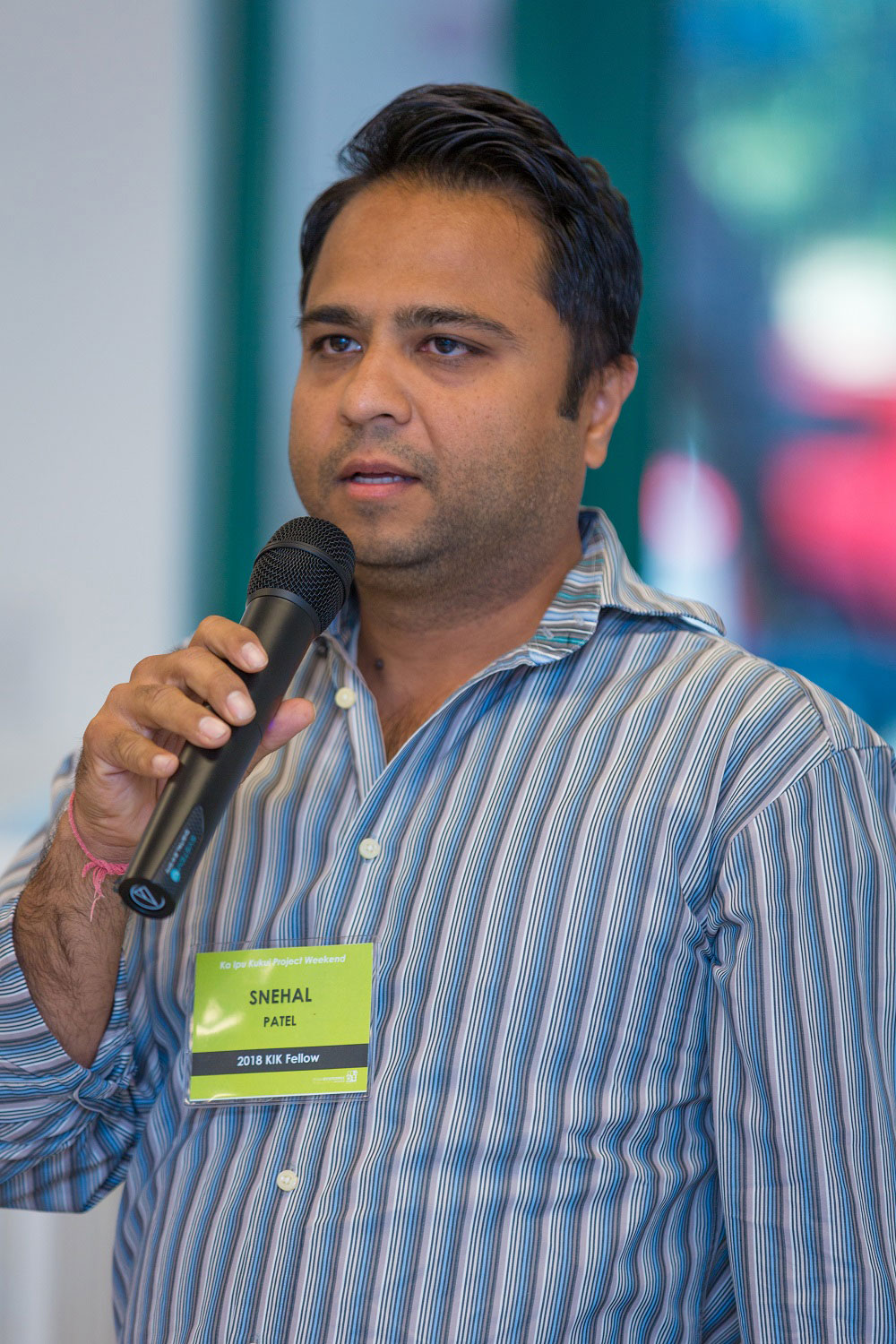
“What I went through was so valuable because it allowed me to realize that even though I have these fears going into it, none of that came about because we had such a great team that we just persevered together and created something that was even more special than I originally thought we could do,” said Snehal Patel who came up with the idea for the winning project called ‘We The People’. “Moving forward we are going to see if we can proceed with our project as a pilot program.”
“I enjoyed the collaboration,” said Sayble Bissen. “We got to learn a lot about how our co-worker Fellows think and how they see Maui as a whole and what can be done to help.” Discussing the future of her team’s project called Literacy for Financial Education (L.I.F.E), Sayble added “Our plan is to hopefully to follow through with our project – I am pretty positive that it can happen.”
As this year’s cohort celebrates their May graduation, Ka Ipu Kukui is accepting applications for the 2018-19 program. Learn more at http://www.kikfellows.org/
I think that we all have such great ideas, and Project Weekend helped us to execute that into a real live MVP (Minimum Viable Project), which I never knew about before going through this process.
Snehal Patel
May 23, 2018 | Environment, Sustainability
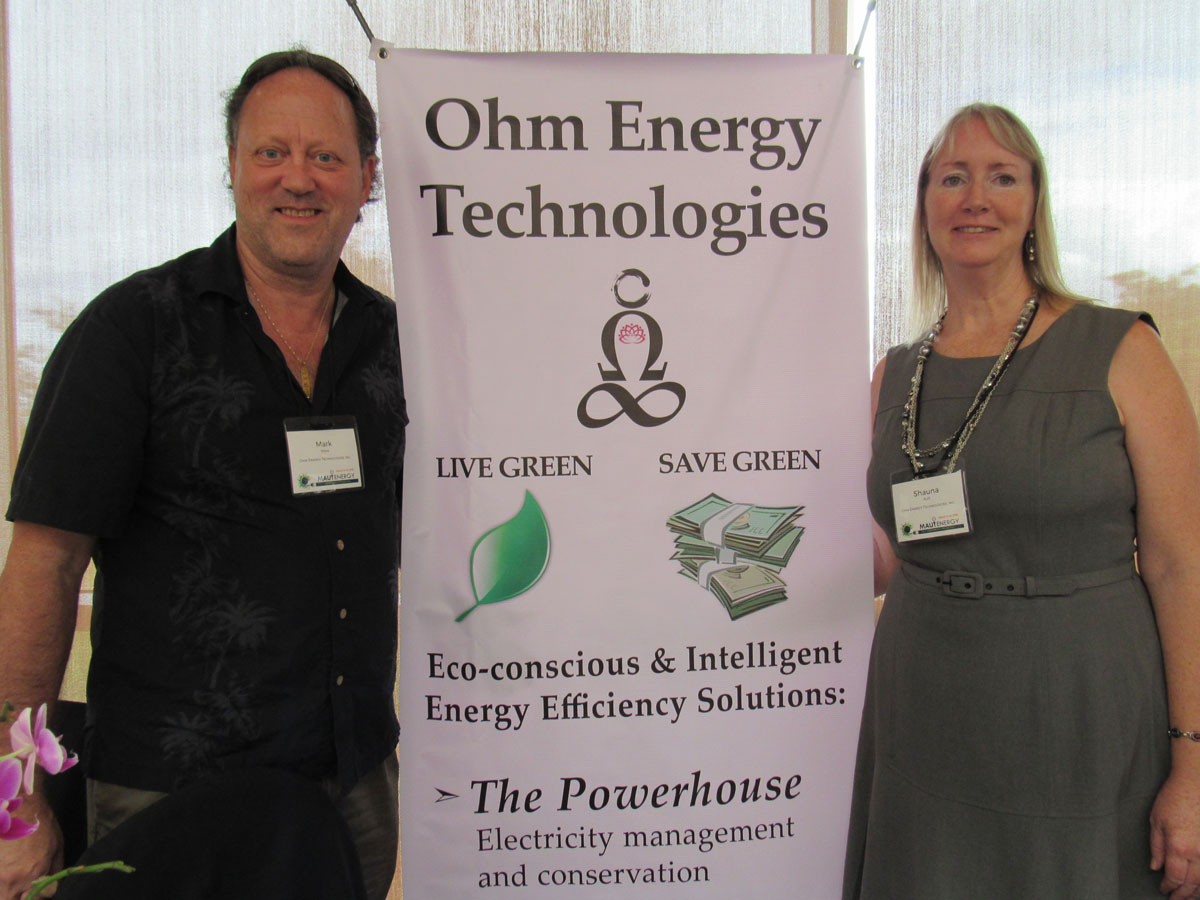
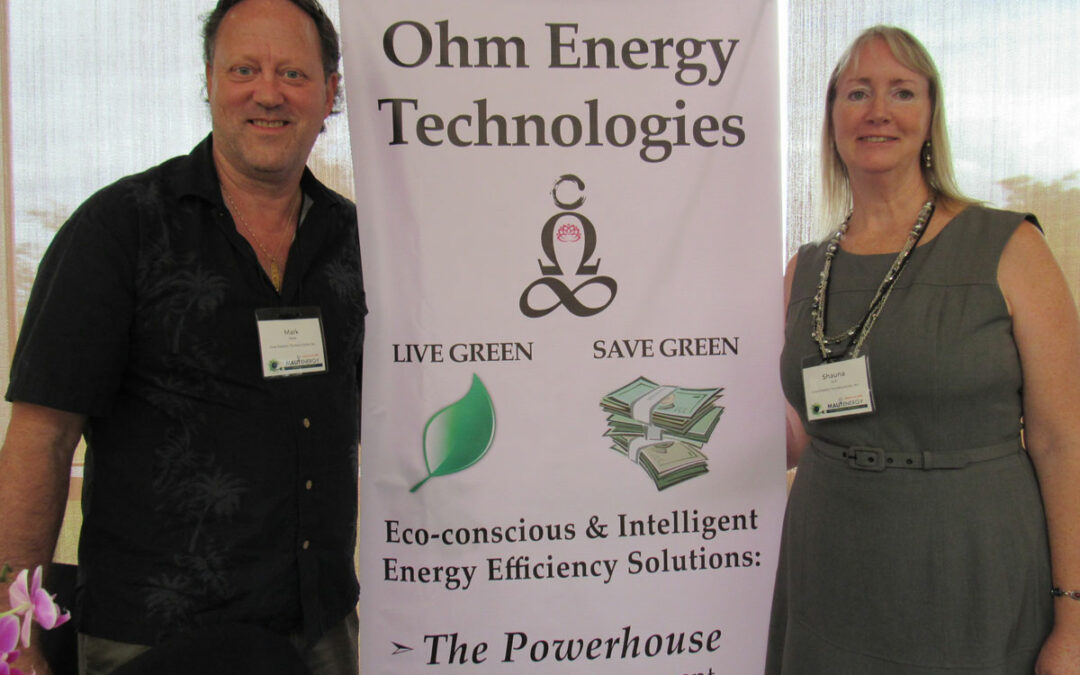
Mark Ware and Shauna Ault of Ohm Energy Technologies, Inc., exhibitors at the 2018 Maui Energy Conference, provide the technical acumen and business management for their family-run company. “Maui called us several years ago, prompting us to create a business that would serve the Hawaii community,” said Shauna Ault. “In 2016, Ohm Energy Technologies relocated from Idaho to Hawaii, to further serve a market experiencing high electricity costs. We are making significant impacts in reducing the consumption of electricity, thus reducing the amount of petroleum fuels burned, as well as saving our customers a significant amount of money on their electricity costs. Hawaii has an aggressive energy efficiency promotion policy, with targets of 100 percent renewable sources of generation by the year 2045. Currently, however, Hawaii still generates approximately 60 percent of its electricity by burning petroleum-based fuels.”
Ohm was established in 2014 to facilitate sales and installation of energy efficiency equipment in a variety of markets. Their primary product, The Powerhouse, was developed by an electrician as a prototype in 2002. It was so successful that it was quickly scaled up to small commercial application. Demand from larger facilities followed. Currently designed for commercial and industrial installations, The Powerhouse has reduced electricity bills by 10, 20, and even 30+ percent, depending on existing efficiency and types of equipment.
“In 2017, Ohm collaborated with manufacturers in California and Maine to develop the next generation of Powerhouse technology: a variable-capacitance system that dynamically adjusts to electricity demand, and a digital internet-accessible monitoring system for rapid access to data and control,” Ault explained. “These systems are now installed in an expanded market on Oahu and Maui, maximizing kilowatt reductions while continuing to provide all other benefits of The Powerhouse. Additional technologies we can implement include state-of-the-art LED lighting for commercial and municipal settings, solar LED street lamps, variable-frequency drives, and harmonic distortion control equipment. With this portfolio of energy efficiency solutions, Ohm Energy Technologies is well positioned to solve many of our energy concerns today, and into the future.”
Hawaii has been our strongest market to date; however, The Powerhouse has been installed in over 700 facilities in the U.S. mainland and Canada.
Shauna Ault, Ohm Energy Technologies, Inc.
May 16, 2018 | Education, Innovation, Stemworks
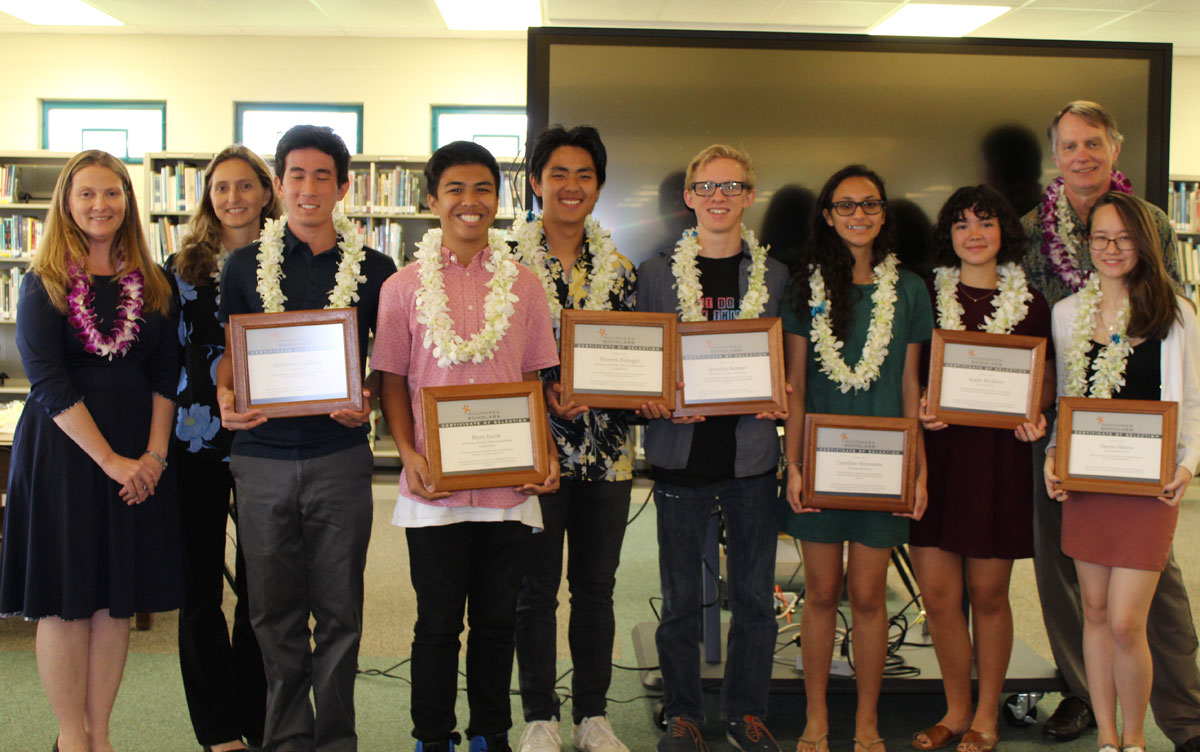
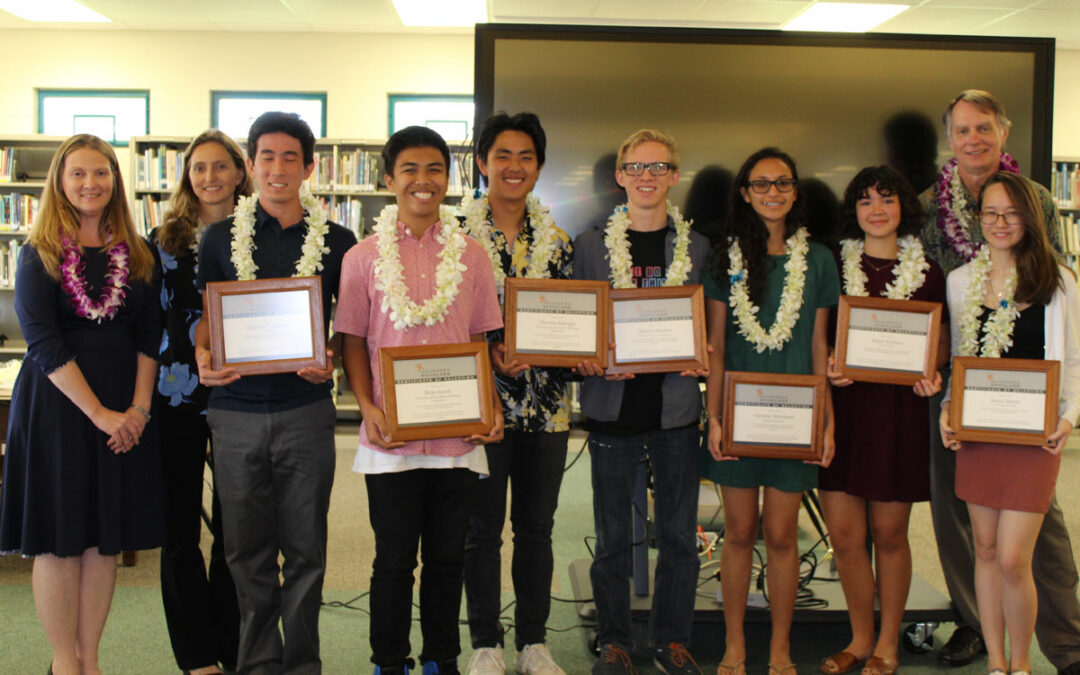
The Maunakea Scholars program, launched in 2015, created an official partnership between the Hawai’i State Department of Education (DOE), the University of Hawai’i, and Maunakea Observatories. Designed to bring Hawai’i’s high school students into one of the world’s most advanced observatory communities, the program’s third group of student astronomers are working with 10 participating international telescopes. Contributing to an innovative STEM (science, technology, engineering, mathematics) curriculum, the Maunakea Scholars provide amazing opportunities to the next generation.
The program pairs a professional astronomy mentor with students in each participating school to coach them through the process of interpreting astronomy data and crafting an original research application. The proposals are submitted to a time-allocation community for consideration, and projects are awarded highly valuable time on participating telescopes, based on the viability of the proposals.
“King Kekaulike is the first Maui school to participate in the Maunakea Scholars program,” said Emily Haines-Swatek, King Kekaulike High School MEDB STEMworks™ AFTERschool teacher. “STEMworks™ students submitted proposals to receive telescope time to conduct real research on an astronomical study of their choice. The Maunakea Scholars program partners with schools to provide observation time and summit tours. Twenty-two King Kekaulike students submitted proposals and seven students were granted telescope time during an awards ceremony on February 14th.” The King Kekaulike Maunakea Scholars and their projects are: Quinton Uradomo on Dark Matter; Janine Harris on Cepheid Magnitude Periods; Quentin Beamer on White Dwarf Formation Temperatures; Ryan Siarot and Thorren Rebiguo on Observing Asteroid Colors to Determine Composition; and Caroline Stevenson and Kayla Wholers on Deep into the Storm. The latter was awarded time on two telescopes, Las Cumbres and Canada-France-Hawai’i Telescope (CFHT).
Haines-Swatek became involved with the Maunakea Scholars after meeting with DOE and CFHT representatives at the 2017 Hawaii STEM Conference. “Because of the proximity to the Institute for Astronomy and the STEMworks™ electives taught at King Kekaulike, we make a perfect fit for the program,” she said. “The project stretched my student’s understanding of astronomy and pushed them to dream of something much larger than themselves. They are looking forward to conducting their research!”
Throughout the year, the Maunakea Scholars program supports each classroom with educational resources, including an integrated indigenous Hawaiian perspective on modern science education, led by ‘Imiloa Astronomy Center of Hawai’i.
Emily Haines-Swatek, King Kekaulike High School, MEDB STEMworks™ AFTERschool Teacher

May 9, 2018 | Community

The world of American Youth Soccer Organization (AYSO), celebrated 53 years of soccer in 2017. Today, AYSO is a successful national and international organization, and is thriving in Hawaii. “The league is committed to the safe development and nurturing of all children,” said Francis Quitazol, Upcountry Maui AYSO soccer coach. “Our main goal is to develop and provide a positive experience for all keiki, promote fitness, teamwork, and the spirit of competition. As coach for AYSO girls, U6 (five and six years old), Quitazol found it very rewarding to watch the girls improve week after week of practice. “My coaching approach for these young girls was to keep it very simple and teach them the basic rules of the game,” he said. “One thing I enjoyed teaching them was the mental aspect of the game. I did this by asking each one of them before the game to show me their game face. At first, they thought a game face is supposed to be an angry expression, but I told them that it should be more of a reflection of their attitude as they prepare to compete. I explained to them that their game faces should convey both confidence and focus. My hope is that in the future they will take their game faces into a final exam or a big job interview and compete harder than they ever did on the soccer field.”
“We love being a soccer family!” said the Felicianos from Makawao. “AYSO’s mission works! They develop and deliver quality youth soccer programs. The season promoted a fun family environment based on AYSO philosophies of good sportsmanship, teamwork, positive coaching, and player development. We have seen the positive effect that soccer has had on our daughter, Moorea. She is learning the importance of exercise, plus all the benefits listed above. We encourage all parents to learn more about joining their local AYSO league, get the children playing, and the whole family out to the games.”
I didn’t even know how to pass or kick the ball when I first started. Now I play with my teammates and when we work together we can make a goal!
Moorea Winter Feliciano, Makawao School, Kindergarten
May 2, 2018 | Education, Innovation
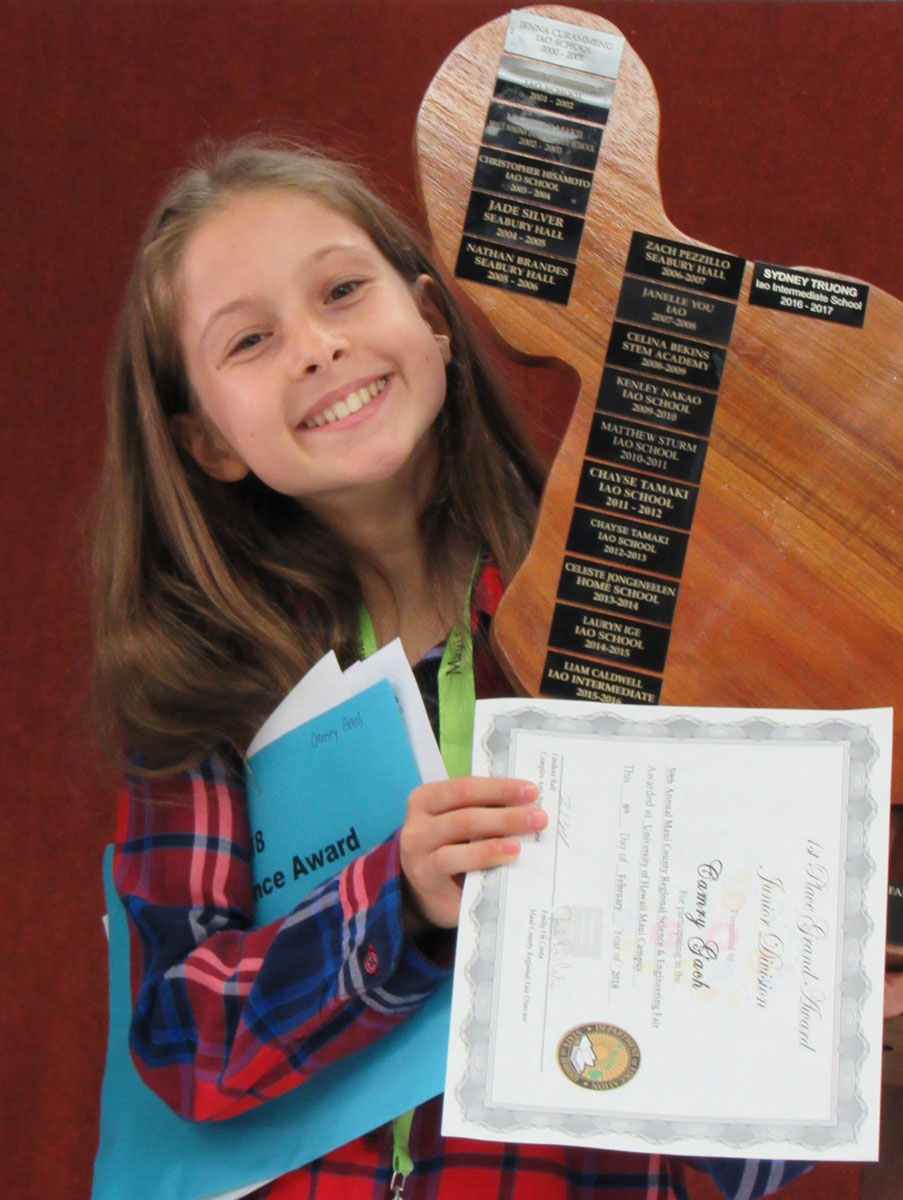
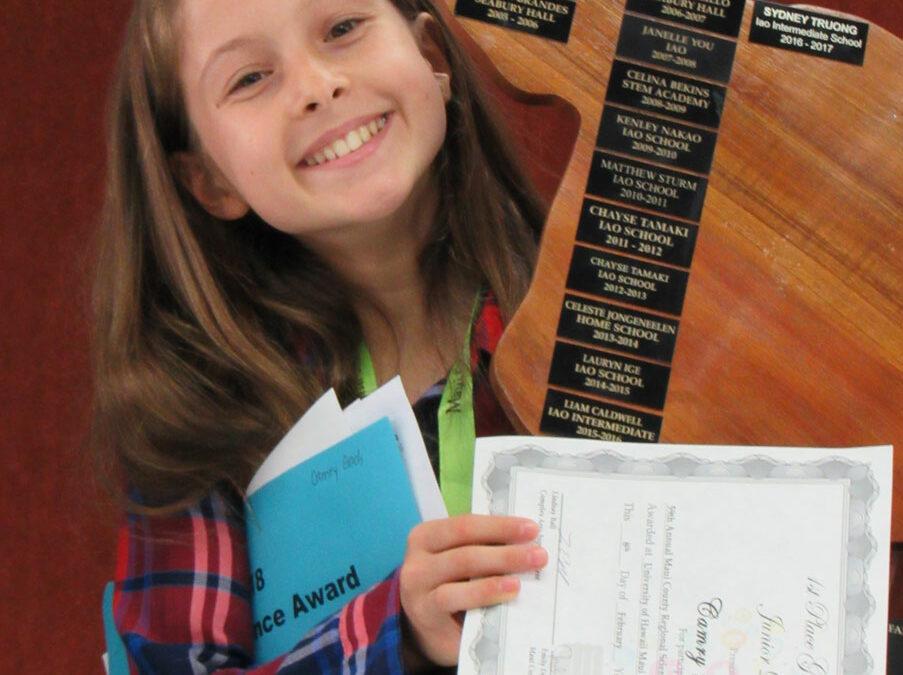
Camry Gach, Seabury Hall 8th grader, is the winner of this year’s 59th Annual Maui County Regional Science & Engineering Fair’s First Place Grand Award – Junior Division; the 2018 Ricoh Sustainable Development Award; the 2018 Broadcom MASTERS; The Best in Energy – Physical Junior Division Award; the Alexander and Baldwin Merit Award – Junior Division; and the Naval Science Award.
“My science fair project, The Effect of Different Lenses and Lights on Solar Power, tested convex, concave, and flat glass at three different heights: 20, 30, and 50 centimeters away from a photovoltaic cell (mini solar panel) to see if they would increase the voltage of the focal point on the cell,” said Gach. “I became interested in this project because I have always been so amazed that energy can be produced from the sun without having to emit a by-product into the air. With such a phenomenal form of sustainable energy, I wanted to contribute to solar panel companies by increasing the voltage that a solar panel produces. I knew that lenses directed light, so I decided to experiment with them to see if that could increase solar voltage. The red light with the convex lens at 30cm from the cell had the highest voltage. The red light mostly had the best results, because it has longer wavelengths than the blue light, which made it travel to the lenses more efficiently.”
Gach’s vision for moving forward with this project is to test a giant convex lens that is bigger than the cell to see if that will increase the output of the whole photovoltaic cell and not just the focal point. “This may increase solar power, because the convex lens will collect light outside the perimeter of the cell and direct that light into the photovoltaic cell,” said Gach, who also would like to continue this experiment by testing with the sun as a light source to represent solar power more realistically. “I feel very excited to continue my project and contribute to solar research.”
I am also interested in testing a Fresnel lens because it uses many lenses and angles to concentrate light.
Camry Gach, Seabury Hall 8th grade