Jan 18, 2017 | Community, Environment
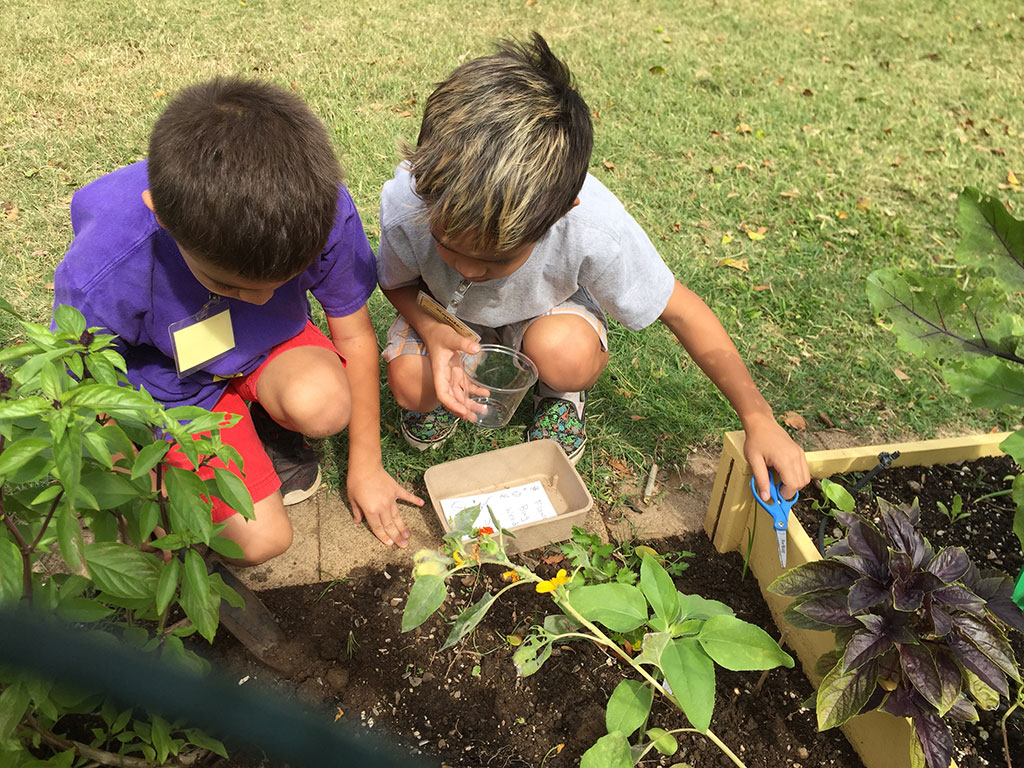
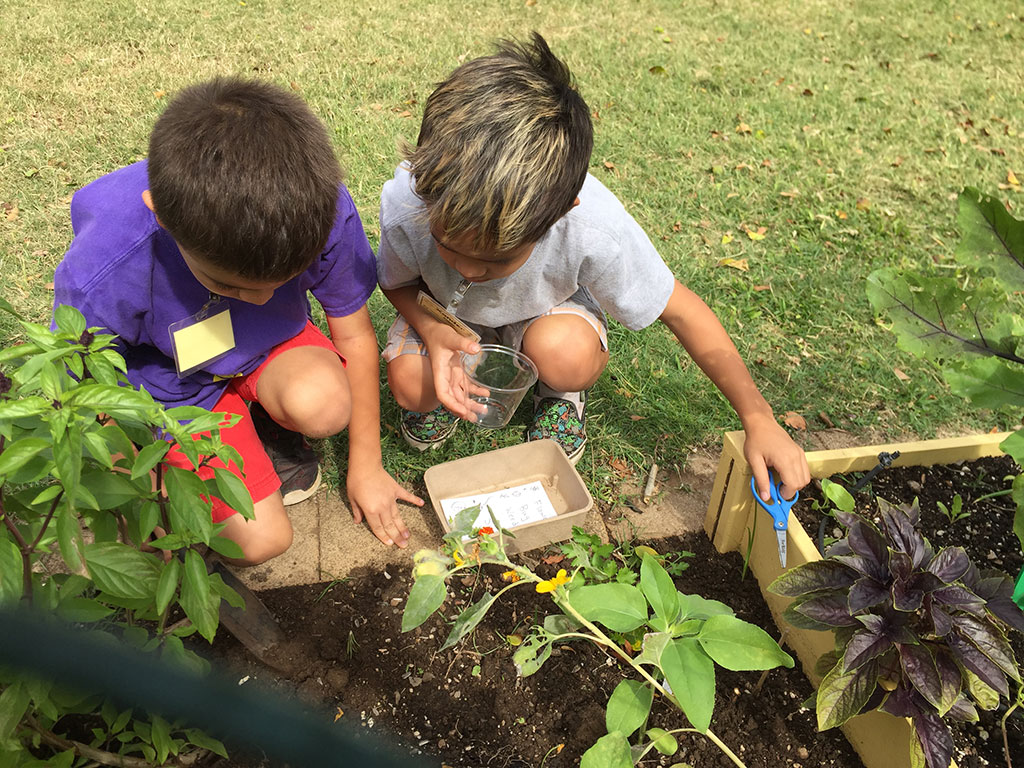
Kahului Elementary School’s 1st grade Grow Some Good (GSG) garden classes recently held Garden Scavenger Hunts as a fun way to review the lessons they have learned so far in the 2016-2017 school year. “Our students learn STEM (science, technology, engineering, mathematics) subjects that help influence their understanding of the natural environment and food,” said Wendy Shishido, first-grade teacher at Kahului Elementary School. “They are able to watch the decomposition process in our compost bin and all the insects and worms doing their part to help make healthy soil. The garden becomes a magical learning space when the youngsters realize we need tomatoes to make pizza!”
Each pair of students was given a collection box, courtesy of Hawaiian Moons Natural Foods, containing a checklist, scissors and a bug cup with instructions to collect the following: a flower; a bug, insect or worm; two weeds; something that smells; and a heart-shaped leaf. “They found that marigolds provided lots of flowers; they hunted down ants, sow bugs and worms; and weeds were easy to come by,” said Nio Kindla, GSG Operations Manager. “Smelly items included the lemon, Thai or Italian green basil, green onions, sage lemongrass or rosemary, which all have strong smells.”
The teacher checked the items for the first pair of students to complete the scavenger hunt. Subsequent pairs of students were checked by classmates. “This is where the real learning came in,” Kindla explained. “As they worked and questioned each other as about whether a plant smelled enough, whether a leaf was heart-shaped enough, how to identify weeds, a real camaraderie grew.”
Students improved their garden literacy, identified and described what they had found, and added new words to their vocabularies. “Some students also learned that keeping an ant in a cup has its challenges!” said Kindla.
The community is invited to GSG’s annual Taste of School Gardens community-wide fundraiser on March 4th, 2017. Guests get to try school garden-inspired dishes from Maui’s top chefs while supporting the school garden programs. For more information, go to growsomegood.org.
Watching 1st graders have that “aha” moment when they realize that what their parents buy in the supermarket is first grown in a garden, is priceless!
Nio Kindla, Grow Some Good Operations Manager
Jan 11, 2017 | Community
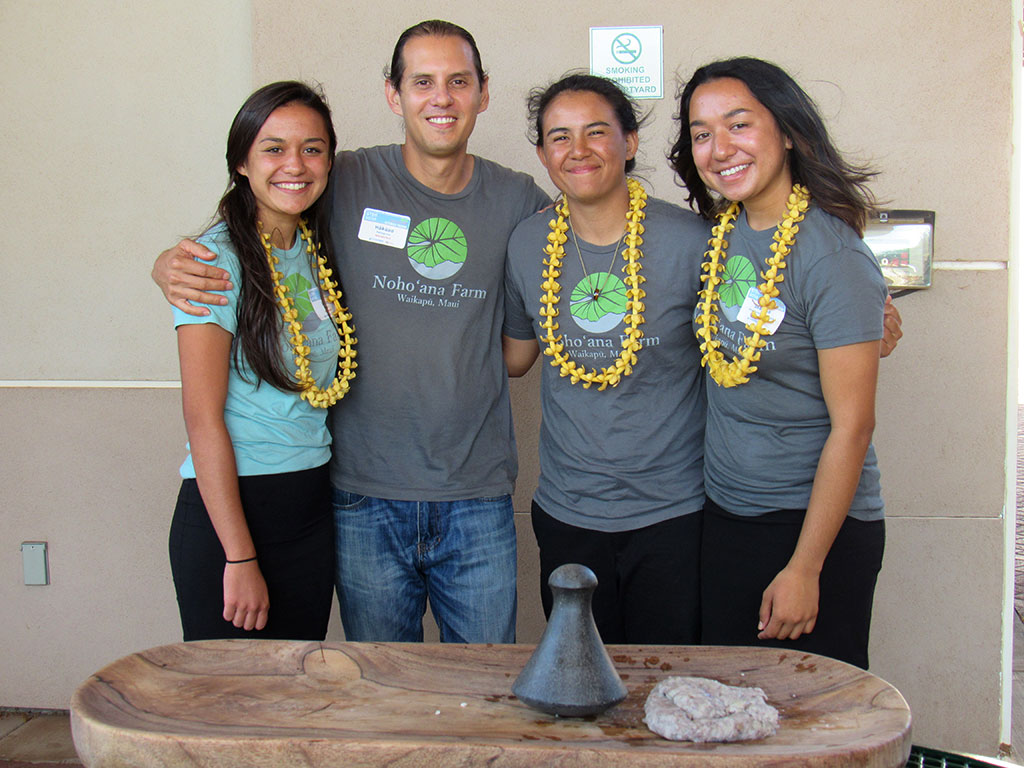
Makahiki is an ancient Hawai’ian celebration of the bounty of the ‘aina (land). It punctuated the yearly farming cycle of ancient Hawaii when the ‘aina was considered a living entity. People really care for it and still do.
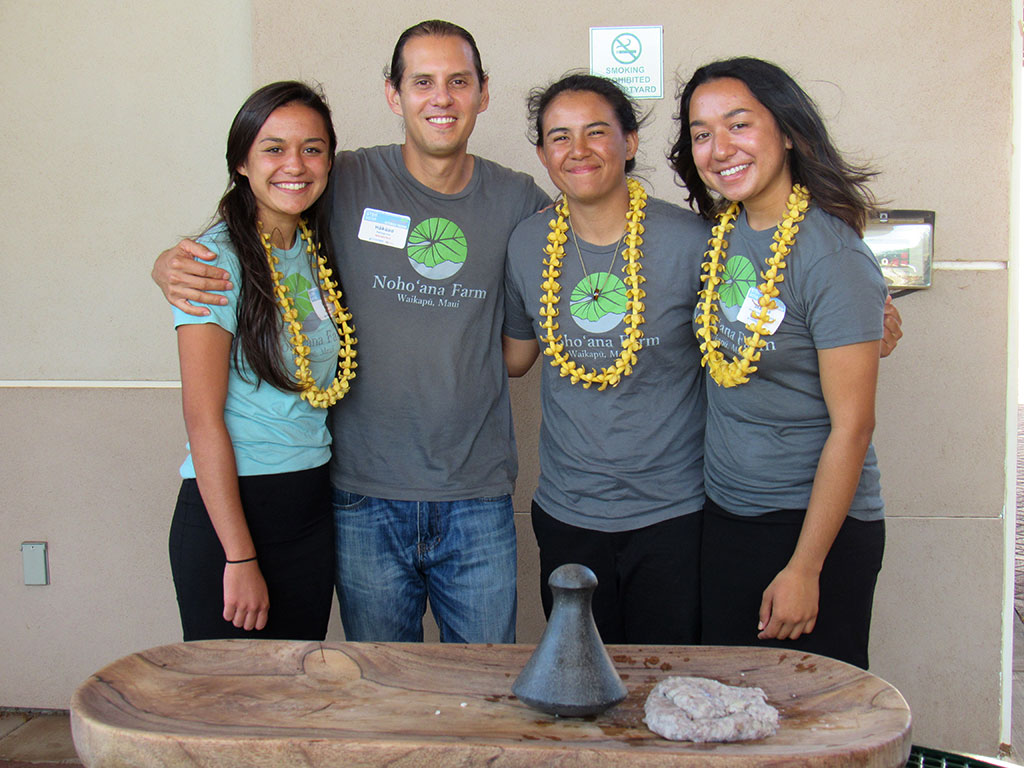
Noho’ana Farm celebrates this natural way of life. As an energy self-sufficient, family-run farm situated on two acres of kuleana (privileged responsibility) land, Noho’ana comprises 12 ancient lo’i kalo stone terraces that are fed via the fresh waters of the Waikapu Stream. Along with kalo, other important Hawaiian and introduced crops are cultivated at the farm using traditional, sustainable and organic farming practices.
“We have developed an ‘aina-based program designed to educate everyone, from children to adults, about the importance of time-honored and sustainable lo’i kalo cultivation,” said Hokuao Pellegrino, owner and manager of Noho’ana Farm. “We teach the methods of traditional crop production, along with the use of plants and food preparation within an instructive landscape.”
“Participants actively engage with the land while learning the appropriate cultural and natural resource management practices,” Pellegrino explained. “Attendees are taught how to harvest the taro, pound the steamed roots into edible paste and cut the stems for replanting. In fact, many of our visitors get into the water and learn how to dig their heels into the mud to harvest the taro.”
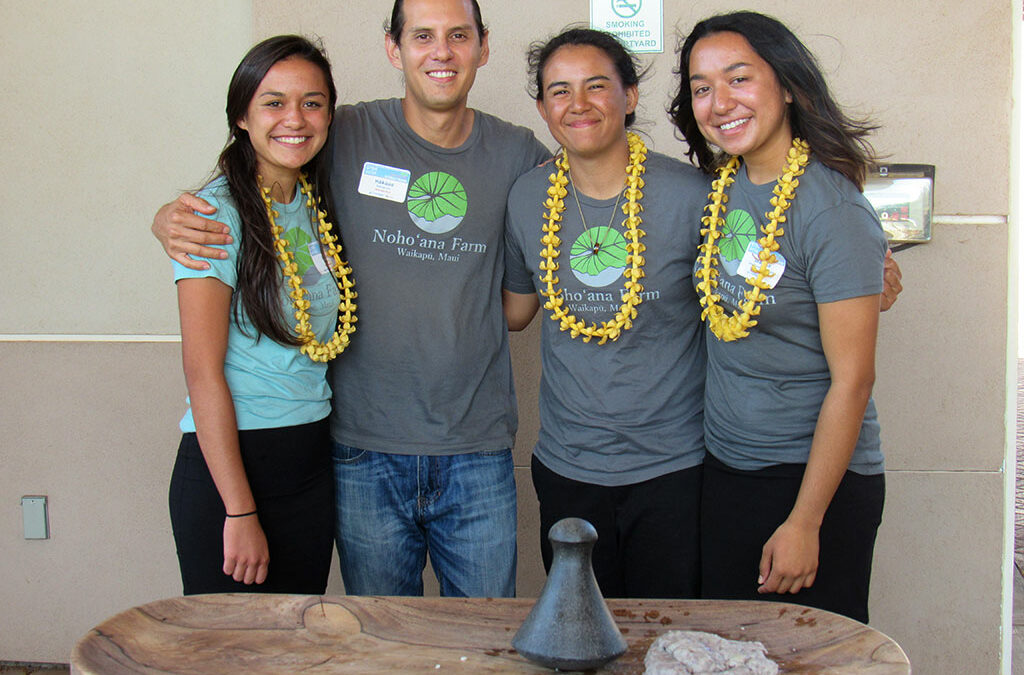
Pellegrino is also a mentor in the Maui Economic Development Board Women in Technology Project, STEMworks™ Summer Internship Program. This year’s Agricultural interns, Noelani Reyes, Kealohalani Ka’aikala and Jade Chihara spent their STEMworks™ internship at Noho’ana Farm. “Our three interns assisted in running our summer culture and place-based program for students in grades 6-7,” Pellegrino said. “Prior to engaging with the younger students, they spent a good amount of time learning how to manage the farm. This included traditional irrigation and water resource management, using farm equipment, planting and harvesting crops, and food production. Behind all of this work they learned many cultural values that are in alignment with their day-to-day responsibilities and an overall appreciation for being food stewards of the ‘aina.”
Our internship at Noho’ana Farm gave us a more prominent concern for environmental issues. We learned that caring for the ‘aina is everyone’s kuleana, privileged responsibility.
Noelani Reyes, Kealohalani Ka’aikala and Jade Chihara, STEMworks™ Summer Interns
Jan 4, 2017 | Education, Stemworks
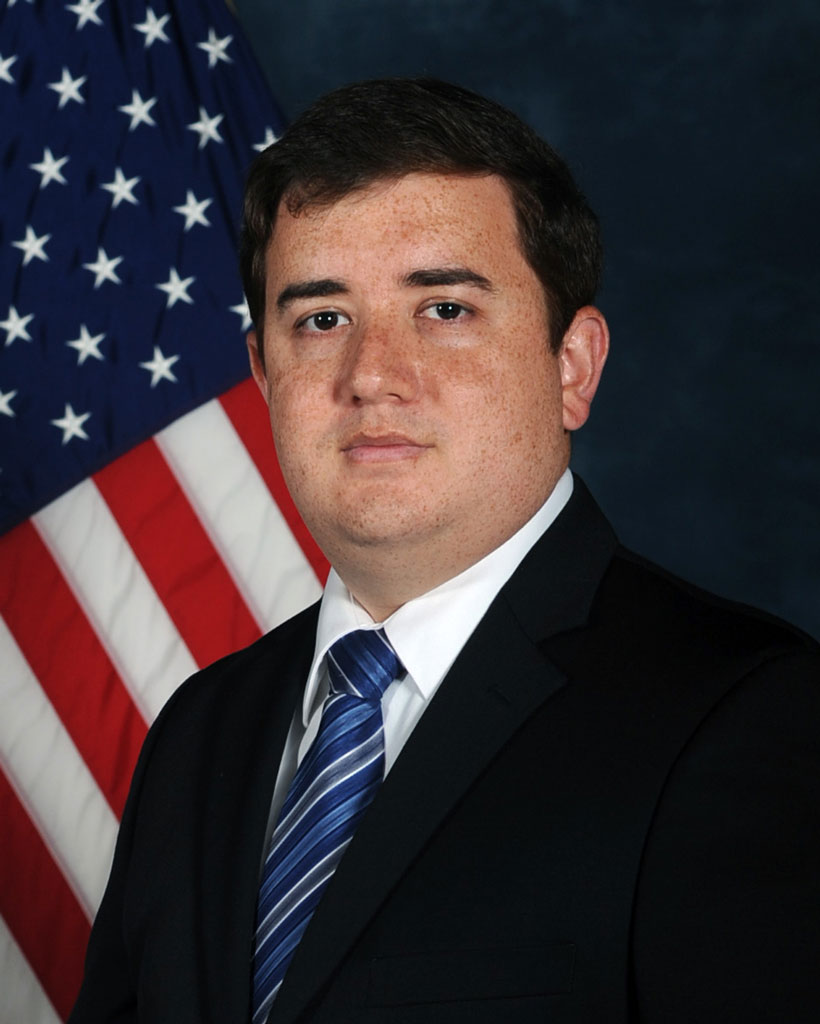
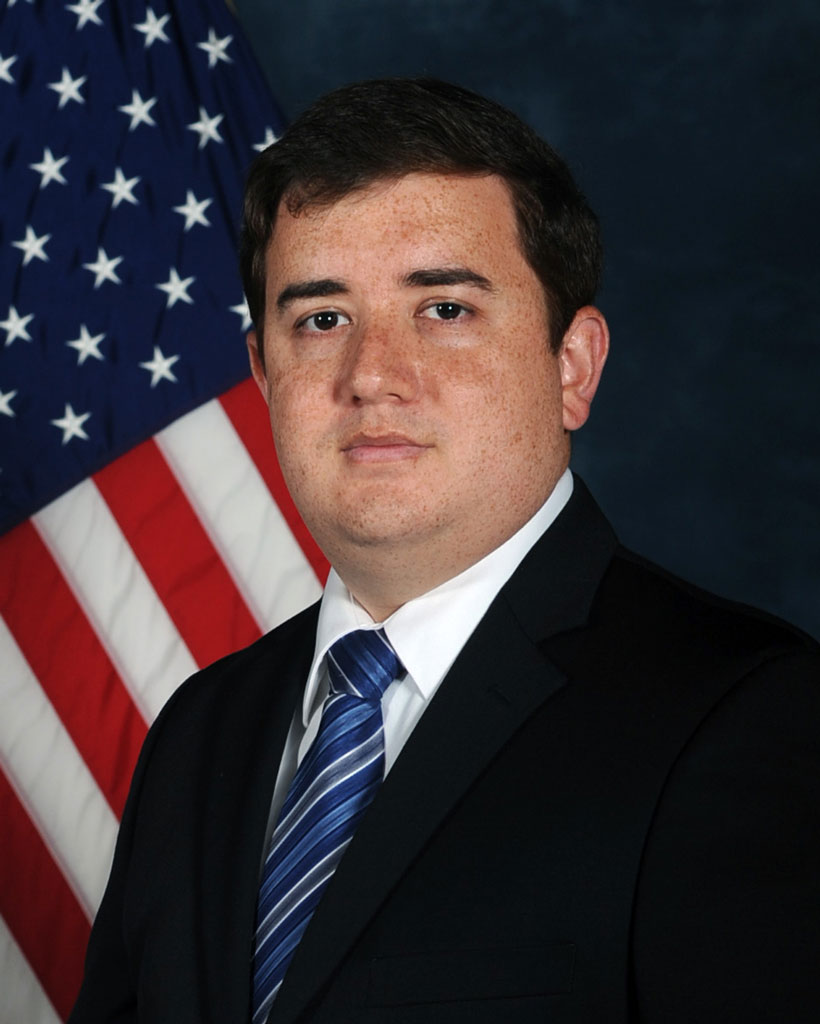
Jonathan Olsten, former STEMworks™ intern
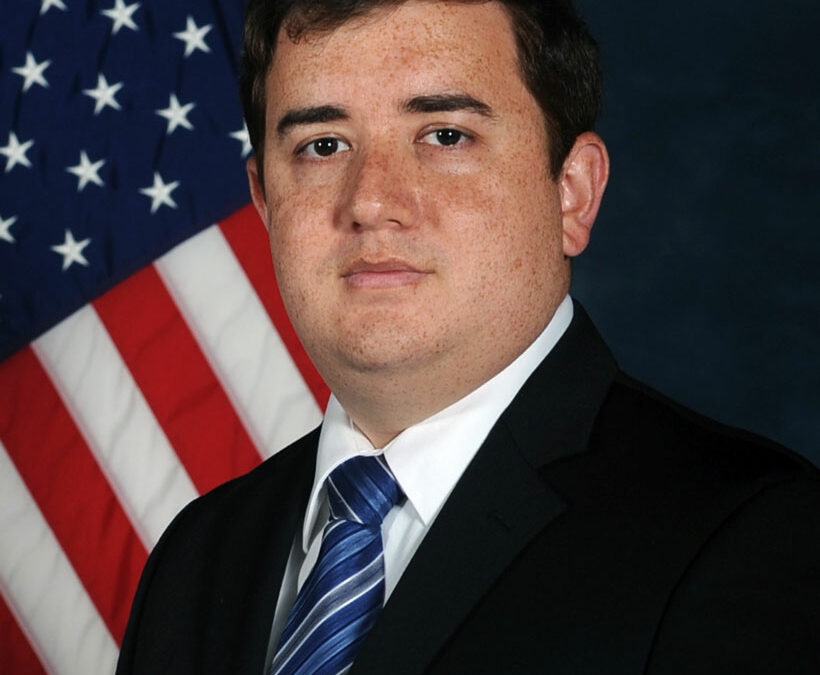
Jonathan Olsten, once a student in Maui Economic Development Board’s (MEDB) STEMworks™ Summer Internship Program, speaks of the importance of STEM (science, technology, engineering, and mathematics) education in his life. “I interned with MEDB while I was in college,” explained Olsten, a Foreign Spacecraft Analyst at the National Air and Space Intelligence Center (NASIC). “Through MEDB I worked at the University of New Mexico’s Maui Scientific Research Center doing data analysis of solar intensity. I took what I learned from that experience and applied it to my current job at NASIC, analyzing large amounts of data.”
Olsten first realized he wanted to pursue a degree in engineering while he was taking high school physics. Understanding the way things work in theory and applying that knowledge in practice, was the kind of academic experience that he found most interesting and enjoyable. “It was nice to be good in math, but math for math’s sake was not as interesting to me,” Olsten noted. “It was learning how to apply the mathematical concepts to solve real-world problems that made math interesting.”
After Olsten decided to pursue engineering, it wasn’t difficult to choose his major. Inspired by a couple of pilots in his family, and a child’s dream to be an astronaut, aerospace engineering seemed like a great career choice. “In fact, one of the first toys I can remember having was a space shuttle,” Olsten said. “My advice for kids still in school is to make sure they end up in a position where they have the tools they need to find the job they will enjoy. That is almost synonymous with STEM. Take electives in high school to decide what kinds of STEM careers interest you most.”
Olsten praises MEDB for the extraordinary job they do in the community. “MEDB’s assistance to teachers and students provides education in cutting-edge technologies,” he said. “MEDB’s programs provide STEM thinking skills that solve real problems in the community and beyond.”
MEDB continues to offer extraordinary STEM programs and internships throughout the year.
Jonathan Olsten, Foreign Spacecraft Analyst, NASIC
Dec 28, 2016 | Community
The Makahiki season, the ancient New Year festival to honor Lono, is still celebrated and practiced by Native Hawaiians, with games, sports and religious ceremonies. Our culturally diverse population also celebrates with fireworks, parties, and special New Year foods, from the Japanese traditions of eating sashimi and preparing mochi, to Portuguese bean soup, Filipino adobo, Chinese dumplings, and Southern black-eyed peas.
The New Year is also a time to make resolutions – affirmations of self-improvement and promises to do good things for others. This tradition dates back thousands of years to Babylon and biblical times and it was in the days of the Roman Empire and Julius Caesar that January 1st came to mark the beginning of the year. It was the Romans that named the first month of the calendar, January, after Janus, the God of beginnings. Janus had two faces, one facing forward and one back, so he could see into the past and the future simultaneously.
The Jewish tradition of Yom Kippur, the Day of Atonement, and the Christian observance of Lent are also precursors of making resolutions in the year ahead. Studies have shown that resolutions that set measurable goals, shared with and supported by others, are more likely to be successful. The most common resolutions include losing weight, eating more healthily, exercising more, and spending more time with family.
Whatever your personal resolutions, Maui Economic Development Board staff would like to be among the first to wish you “Hau‘oli Makihiki Hou” and the very best for 2017 – Happy New Year!
As the New Year approaches, MEDB would like to be among the first to wish you Hau‘oli Makihiki Hou – Happy New Year!
Dec 21, 2016 | Community, Environment, Sustainability
 The Fairmont Kea Lani Resort, venue for Maui Economic Development Board’s annual Ke Alahele Fundraiser, is committed to responsible tourism practices and sustainable hotel management. “Our Sustainability Team, created in 2001, is comprised of leaders and colleagues dedicated to “greening” our operations and cultivating an enduring connection to the land and community,” said Rick Texeira, Chair, Fairmont Kea Lani Sustainability Team. “To date, the Sustainability Team has launched over 50 environmental initiatives at the resort, including the installation of over 1,528 solar photovoltaic panels, efforts in support of the critically endangered Hawksbill sea turtle at neighboring White Rock beach, and our sponsored Earth Day community reef clean-ups, to name a few.”
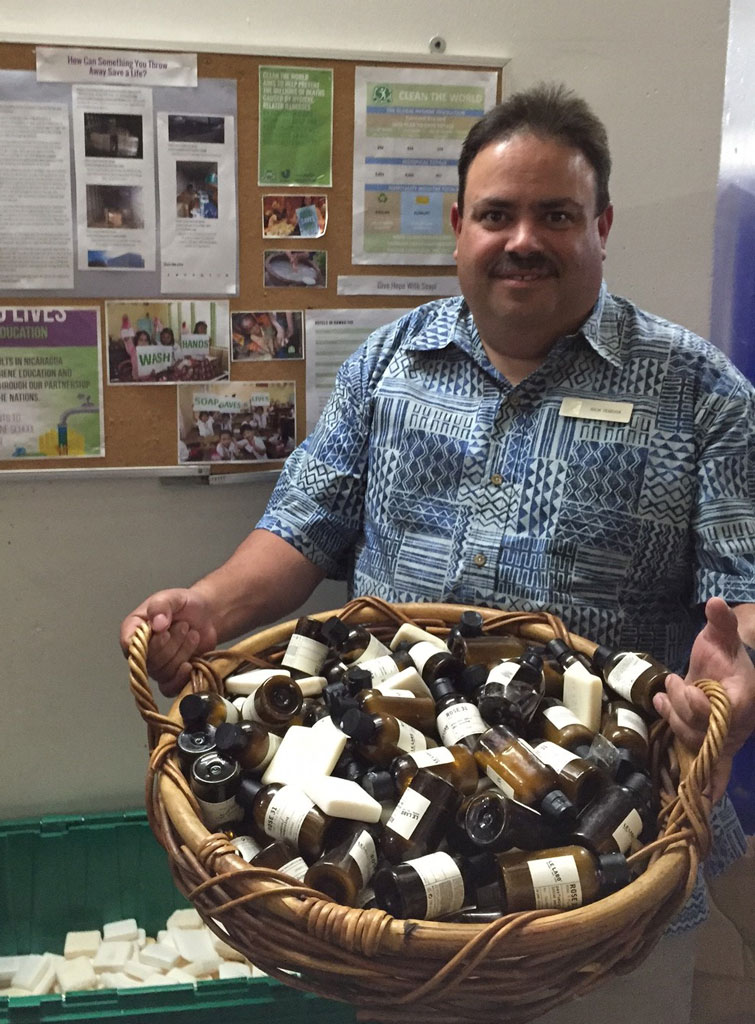
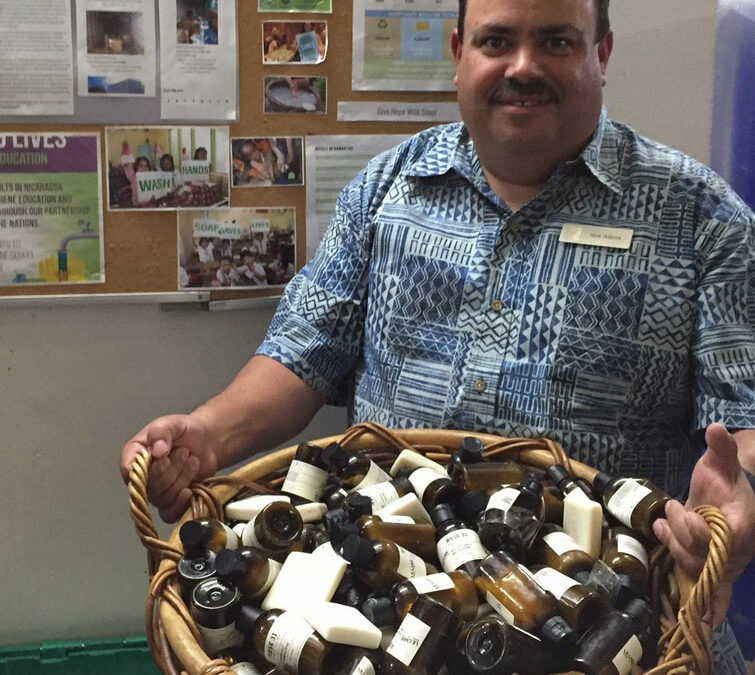
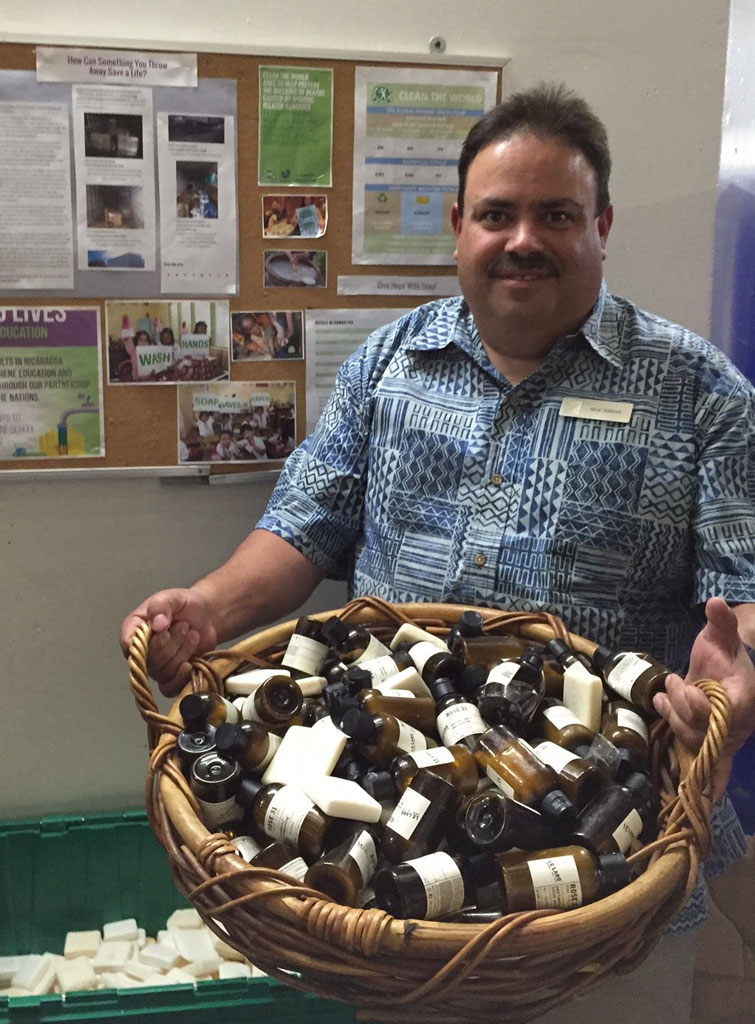
An especially interesting Kea Lani program, in partnership with Clean the World Foundation, Inc., recycles hygiene products, soap and bottled amenities for worldwide distribution to fight hygiene-related illness. “Clean the World takes our unused soap, shampoo, conditioner, lotion, and shower gel and gives them a second life through a global hygiene initiative,” Texeira explained. “The distribution of recycled soap and hygiene products from hotels and resort partners helps millions of people in countries with a high death rate from these illnesses.”
Recycling with Clean the World and other sustainability projects are a great way to achieve corporate social responsibility goals and attract more guests. “The programs increase employee morale and visitors love it as well,” said Texeira. “I’m so proud of the commitment and effort our hotel has shown. Not only are we recycling, we are helping those in need and supporting the health and wellness of others. It is wonderful to see how simple and responsible acts can save so many lives. We look forward to continuing our sustainable movement for many years and are passionate about our efforts to make a difference for people, our communities and the planet.”
Our hotel has contributed to Clean the World’s distribution of soap, amenities, and hygiene kits in 96 countries.
Rick Texeira, Chair, Fairmont Kea Lani Sustainability Team