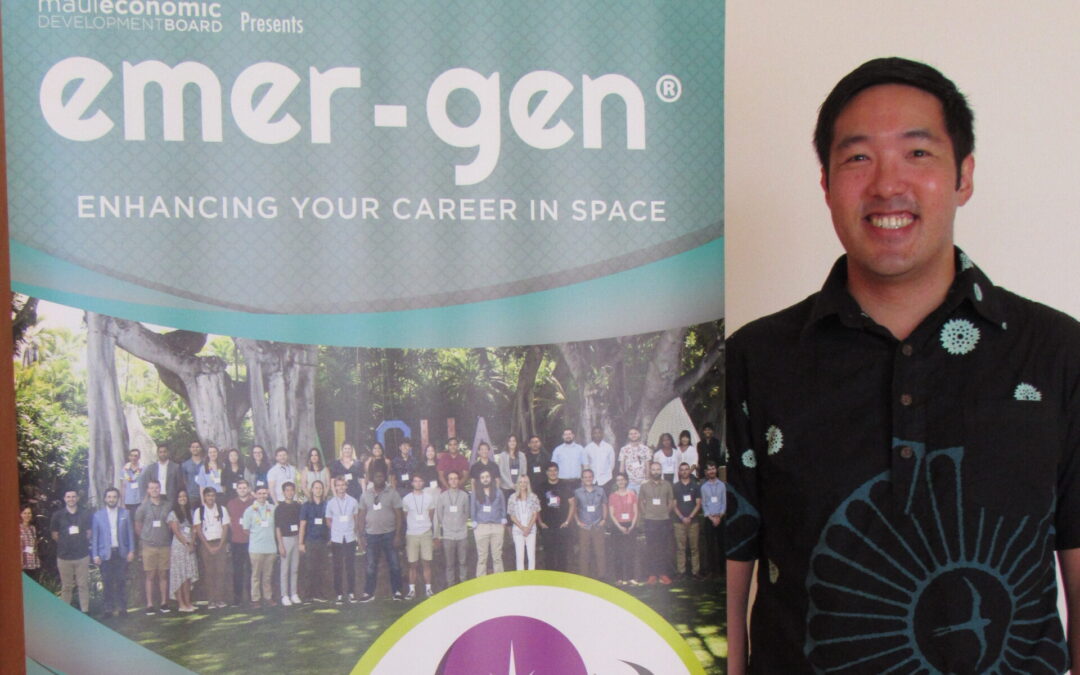
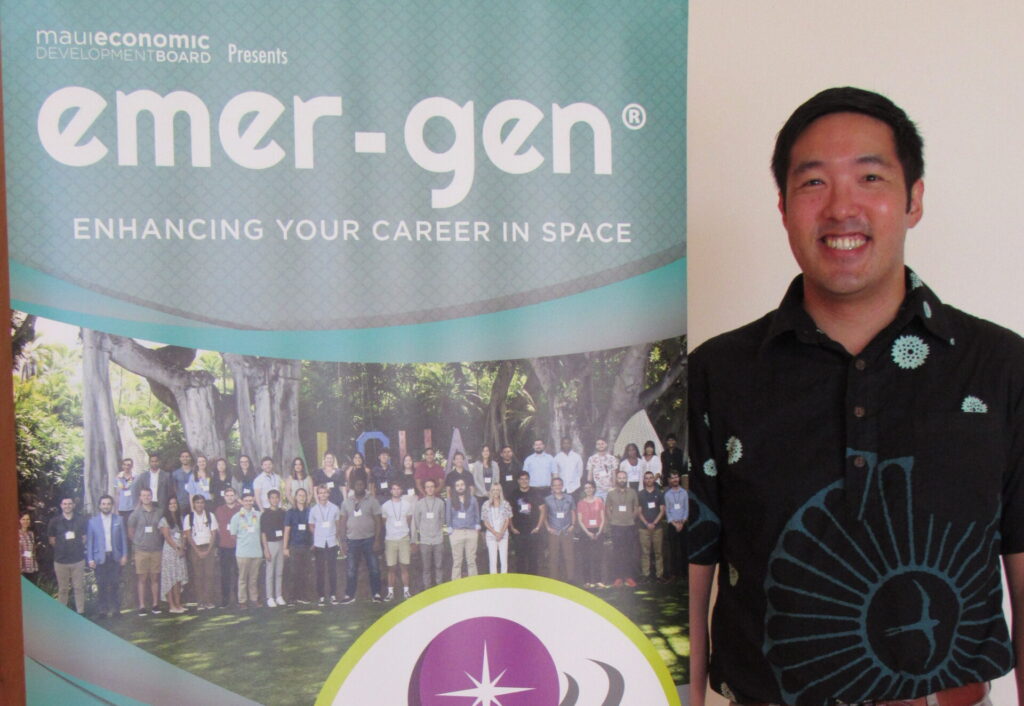
Devin Chu, Resident Astronomer at ʻImiloa Astronomy Center at the University of Hawaiʻi in Hilo, was a cultural speaker at the 2026 9th annual EMER-GEN Program on Maui. Designed for young professionals and students, ages 18-35 and enthusiastic about careers in space-related fields, EMER-GEN offers interactive specialized development sessions in a global environment. ‘Imiloa is a bilingual science center in ‘ōlelo Hawai’i (Hawaiian language) that showcases Polynesian wayfinding and astronomy. Chu’s talk, Wayfinding Through Time: Voyaging, Language, and the Revitalization of Hawaiian Knowledge, centered on the importance of ‘Olelo, A Hua He Inoa, preserving cultural significance for science.
“After Hawai’i was settled, oceanic trade routes continued,” Chu explained. “It was when the Pacific trade routes stopped that wayfinding knowledge was almost lost. Hōkūle’a (Star of Gladness, and Hawai’i’s zenith star) was built to revitalize traditional wayfinding by Master navigator Mau Pialug of Satawai. He navigated Hōkūle’a on her maiden voyage and taught his knowledge to a new generation of navigators committed to educating future navigators. Also, a revitalization movement of Olelo Hawai’i, teaching the language at a young age, is being restored with immersion schools for all ages.”
Chu’s life and career were literally written in the stars. Growing up in Hilo, he would often visit the library on weekends with his mother. After graduating from Hilo High School in 2010, Chu’s journey took him to Dartmouth College, and all the way to UCLA where he earned his Master of Science and PhD in astronomy and astrophysics in 2016 and 2020, respectively.
“In the third grade, one of the books I discovered was Our Solar System, which got me fascinated with the neighboring planets and their differences from Earth,” Chu shared. “As UH’s astronomer-in-residence at ʻImiloa, I’m looking forward to immersing myself in the development of ʻImiloa’s curriculum, expansion of educational outreach programs, and further development of place-based partnerships with the community to get Hawaiʻi Island students interested in astronomy and other STEM-related fields.”
Attendee Jordan Marshall from Scout Space said, “The Hawaiian culture is so fascinating! Through wayfinding and education, Devin showed us how Hawaiians are revitalizing their culture and language. Navigating by the stars and using Hawaiian names we learned the importance of using cultural values in modern technology.”
It’s so inspirational to learn about the Polynesian voyages, the connections between the stars and the constellations, and how they play a major role in wayfinding.
– Devin Chu, Resident Astronomer at ʻImiloa Astronomy Center, University of Hawaiʻi in Hilo
Thirty-eight delegates, including fourteen Hawaiʻi-based, participated in the 7th EMER-GEN® Program, presented by Maui Economic Development Board (MEDB) in September. A joint initiative of the AMOS Conference and the Space Generation Advisory Council (SGAC), the program is designed to foster innovation and entrepreneurship especially for young professionals and students who are enthusiastic about careers in space.
“The program encourages participants to think creatively, collaborate in teams, and develop innovative solutions at both a technological level and a policy level,” said Annette Lynch, MEDB Director of Communications. “The diverse range of activities and speakers helps participants enhance both their technical expertise and leadership capabilities.”
Maui resident Matthew Lugo, a Privateer Space engineer, EMER-GEN alumnus, and member of the EMER-GEN planning committee, emphasized, “EMER-GEN is also known for its focus on Hawaiian cultural subjects. I feel it’s important for those in the space industry to be stewards of the Earth environment as well. Space technologies should benefit the sustainability of the planet.”
Lugo continued, “This year, along with two international SGAC representatives, we invited Michael Nāhoʻopiʻi, Executive Director of Kahoʻolawe Island Reserve Commission (KIRC) to share an update about the island. The island of Kahoʻolawe is just seven miles off the coast of Maui. It is managed by the KIRC team, who are working towards a restoration of the island.”
Nāhoʻopiʻi explained, “The history and culture of Kahoʻolawe is indeed rich. It is believed to have been inhabited since about 400 A.D., and the abundance of historical and archeological sites paints a picture of the island as a navigational center for voyaging and a center for agriculture. Modern times have been less kind. The island has been home to a penal colony, a sheep and cattle ranch, and a U.S. Navy bombing range. Those land uses were detrimental to the island’s delicate ecosystem and led to severe habitat degradation. The KIRC team has taken on the challenge to restore these habitats with on-the-ground hard work coordinated by expert assistance. In addition to physically restoring the island of Kahoʻolawe, we are undertaking the cultural restoration of the island.”
Space exploration provides us with more information about protecting our planet, our environment, and improving our day-to-day lives. Everything is connected!
Michael Nāhoʻopiʻi
Executive Director
Kahoʻolawe Island Reserve Commission
Past participants of Maui Economic Development Board’s EMER-GEN program, Amber Imai-Hong, program manager and avionics engineer at Hawaiʻi Space Flight Laboratory (HSFL), and Yosef Ben Gershom, operations manager at HSFL, are thrilled about HSFL’s unprecedented opportunity for hands-on involvement in space exploration. Their Hyperspectral Thermal Imager (HyTI) satellite was launched by NASA to the International Space Station (ISS) and was recently deployed from the ISS for use.
The imager will gather valuable data for understanding Earth’s surface processes, including volcanic activity, wildfires, and soil moisture levels. Led by Principal Investigator Robert Wright, director of the Hawaiʻi Institute of Geophysics and Planetology (HIGP), the project began in October 2018 with funding from NASA’s In-Space Validation of Earth Science Technologies Program.
Imai-Hong recalled, “When we started the HyTI project in 2018, we did not imagine how much our team would have to overcome or how much we would learn along the way. Developing one of the most advanced imaging cubesats was challenging, and it feels great to know we are operating HyTI on orbit!”
Gershom explained, “The mission has been an incredible opportunity for training our local aerospace workforce and for students. It provides real-world experience working with professional engineers on a NASA mission with real requirements and hardware. That is why we work on complex projects here at UH,” he said, quoting JFK, “not because they are easy, but because they are hard.”
HSFL trains dozens of MEDB’s STEMworks™ interns and alumni. Gershom added, “It takes a multitude of different people, in different fields, to develop a mission such as this. I see this NASA mission as another steppingstone for UH and Hawaiʻi to become more noticed in the broader space community. I hope it will get the word out locally that people can stay in Hawaiʻi and work on incredible space projects if that is their passion. This mission shows that talent exists throughout the islands and that we can provide opportunities for people to stay and work where they grew up. This is a big step for UH and for the Hawaiʻi aerospace community.”
We are proud of our EMER-GEN friends, the team of students, researchers, and UH faculty involved in this mission. We are thrilled to watch the HyTI satellite begin the next phase of processing high-resolution thermal images.
Leslie Wilkins, President & CEO, Maui Economic Development Board