Jan 25, 2012 | Small Business

From left: Sisters Gail Saito and Cindy Tasaka-Ing and their cousin, Kelly Kohatsu
A family business with nearly 100 years of history lives on today in Cindy Tasaka-Ing and her sister, Gail Saito. The two are the owners and operators of Tasaka Guri-Guri, a homegrown snack shop founded by their greatgrandfather Jokichi Tasaka. He created the store’s hallmark guri-guri, a frozen dessert featuring a cross between sherbert and ice cream. Guri-guri is served in scoops of two flavors — strawberry and pineapple. Tasaka’s son, Gunji, perfected his father’s recipe, and his sons, Setsuo and Henry — Cindy and Gail’s dad — kept the recipe secret and continued the thriving business for about 35 years until retiring recently when the operations were officially handed to Henry’s daughters.
Cindy and Gail have one other employee, their cousin, Kelly Kohatsu, and get a lot of help from Henry’s long-time friend, Tony Ishikawa. “It’s a small business, we’re doing okay, why change it?” Cindy Tasaka-Ing said. Aside from the secret family recipe for guri-guri, Cindy and Gail manage Tasaka Guri-Guri just like their great-grandfather, grandfather and father did — no computer, no fax, no copier, no Web site. “Our business comes from word of mouth,” she said. Tasaka Guri-Guri switched from its site at the old Kahului Center nearly 100 years ago to the Maui Mall where they’ve had the shop for about four decades now.
Tasaka-Ing said the store welcomes a range of people from loyal residents who stop by every day for a scoop of guri-guri to visitors from the Mainland and others who want to take a quart or two to the Neighbor Islands. Tasaka-Ing said the shop has been successful in part “because our prices are relatively low.” Two scoops of guri-guri in a cup is priced at $1.20 and rises up to five scoops for $2.85; it can also be bought by the quart. Tasaka-Ing said she and her sister aren’t interested in selling the family recipe and hope that one day, their own children — most of whom are 12 years or younger — will take over the business.
Jan 18, 2012 | Community, Environment

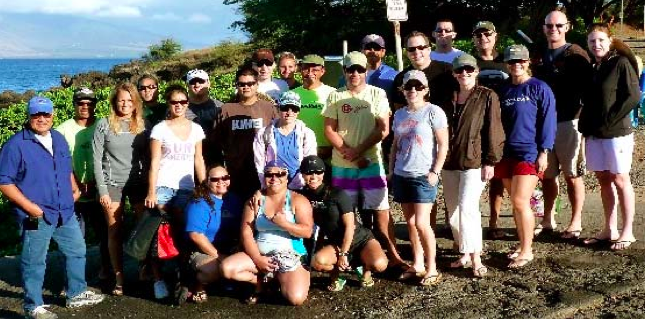
A community service project on Kaho‘olawe turned into a renewed appreciation for the Hawaiian culture and the value of giving back. That’s what Kevin Gavagan of the Four Seasons Wailea said happened to some 35 hotel employees and their families when they volunteered to plant trees on Kaho‘olawe. “We went to give and we got so much back, Kaho‘olawe enriched us,” said Gavagan, a Native Hawaiian employed as the assistant director of engineering at the Four Seasons. Gavagan spearheaded the volunteer effort, leading two separate trips to Kaho‘olawe toward the end of last year. Employees gave up their vacation time for a four-day journey that featured two full days of tree planting, an island tour and lessons on Hawaiian history. Their employer, the Four Seasons, picked up the access fees to the island, priced at $125 per person. In honor of the hotel chain’s 50th anniversary, Four Seasons set a goal to plant 10 million trees around the world. The Four Seasons at Wailea kicked off their contribution to the goal by planting some 250 trees on the hotel property on Earth Day in April of last year. Gavagan followed that up by coordinating the tree-planting project on Kaho‘olawe.
There is archaeological evidence that Kaho‘olawe, the smallest of four islands in Maui County, was occupied by Native Hawaiians since 1000 A.D. It was taken over by the U.S. military after the outbreak of World War II and used as a bombing range for more than 40 years. After a $400 million cleanup of unexploded ordinance of the island, it was returned to the state of Hawaii in 2003. Now, the island is overseen by the Kaho‘olawe Island Reserve Commission. There are plans to do more tree planting in 2012. Gavagan said his views of Kaho‘olawe have changed his visits. “You get a completely different appreciation for the island when you step foot on it,” he said. “It really was a transformation for me and got me closer to Hawaiian traditions. Everybody wants to know when they can go back,” Gavagan said.
Jan 11, 2012 | Community
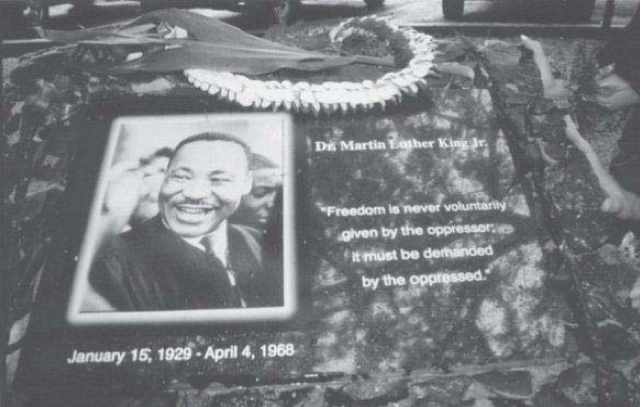
Dr. Martin Luther King, Jr. Stone of Hope Monument, High Street, Wailuku
Maui retirees Terri and George Rainey have been involved in planning and promoting Martin Luther King Jr. Day celebrations in Hawaii for nearly two decades now. Terri Rainey recalled meeting the late civil rights leader for the first time in 1961 at her church in Los Angeles. “He inspired all of us to always do good and help others to help make a difference in their lives. I have carried his message with me all my life,” she said. Rainey and her husband, George, founded the Dr. Martin Luther King Jr. Coalition-Hawaii (Honolulu) and have extended it to Maui. The Coalition has been working with the nonprofit African Americans on Maui Association to coordinate events on Maui.
Rainey said it is the goal of the Coalition, which includes the Maui division, “to educate the community, especially the younger generation, about Dr. King, his principles, and how important it is to preserve his memory.” The 2012 Maui celebration runs throughout the week and officially opened Jan. 9 with Mayor Alan Arakawa signing a proclamation acknowledging the County of Maui’s recognition of the Dr. King holiday and his legacy. “Dr. Martin Luther King, Jr. was a leading advocate for civil rights through non-violent means nationally and internationally, and we shall honor his memory through our actions and deeds as a tribute to his legacy,” Rainey said. Residents can learn more about King by visiting the island public libraries to see special book displays made in tribute to King. There are also churches including Grace Church, Ka‘ahumanu Congregational Church and the Temple of Peace in Haiku, which are holding services honoring King on Sunday, Jan. 15.
Celebrations culminate Monday, Jan. 16, with an inaugural bell ringing at 8 a.m. at the Ka‘ahumanu Congregational Church in Wailuku. A ceremony follows at the Dr. Martin Luther King Jr. Stone of Hope Monument in front of the County Building on High Street. The Stone of Hope monument, the only one of its kind in the State, was dedicated in 2006 in memory of the life and legacy of Dr. King. From there, a march continues on to Market Street. The holiday will close with an entertainment program from 3 to 6 p.m. at the Queen Ka‘ahumanu Center stage. All events are free and open to the public.
Jan 4, 2012 | Community
 Continuing our series on County Department leadership, reflecting the role of government in responding to community values and needs.
While residents enjoy the peace of living on an island with a relatively low crime rate, the job of maintaining public safety falls to Maui County Police Chief Gary Yabuta and the more than 400 employees of the Maui Police Department. “I have a great team,” said Yabuta, who joined the department as an officer in March 1983 and became chief in June 2009. “It’s a diverse organization with a variety of people who have highly technical skills.” “The greatest resource we have is our officers and our employees,” he said.
As of mid-December, the department has 344 officers out of 375 positions allocated and another 117 civilian employees. Yabuta has taken the step of opening dialogues with communities, holding several public meetings this past year. “I enjoy working with the community,” he said. “Our goal is to remove the fears of the community in their own neighborhoods.” Yabuta said his department is working hard to develop community partnerships and educate the community about crime. One of those steps was to develop, with the assistance of The Maui News, the weekly Crime Watch feature on Mondays that reports on property crimes throughout Maui County.
Another effort has been to continue work with establishing Neighborhood Crime Watch groups, which are organized neighborhood, residential or retail areas that come together to look out for each other and report suspicious activity to police. There are at least 45 such groups throughout Maui County, and Yabuta said he’d like to see more. The department continues its efforts to educate young people about the dangers of drugs and alcohol through its drug and alcohol resistance program, better known as DARE. That program has expanded to include anti-bullying education. Yabuta acknowledged that many officers and civilians in his department also work closely with the community on their own time, participating in a variety of charitable fundraisers and community events. “It’s not the chief telling them to do this. Good officers, good employees, they make the time to assist and help their own community; it’s what makes great character and a good law enforcement officer and employee.”