Dec 1, 2010 | Education
 Iokepa Nae`ole proudly traces his family’s ancestry back to the time of King Kamehameha’s infancy, on the Big Island. Teaching comes naturally to Nae`ole and the vocation has always run in his family. Many know Nae`ole as a canoe paddling coach; he has been an integral part of the statewide success of the Kahului-based Hawaiian Canoe Club and helped guide King Kekaulike High School to a State paddling championship in 2004. He is also an active environmentalist, cultural advocate, and mentor.
 Nae`ole’s latest project is the Hawaii Outdoor Experience, a pilot educational initiative funded by the State Office of Youth Services and administered through Neighborhood Place of Wailuku. The program provides up to 80 teenagers with after-school and weekend activities, and “campovers”; parents are invited to go through the program too. Ropes courses offer team building, personal development, trust and leadership skills. Canoe paddling provides a healthy outlet and a metaphor for community life. To function successfully, a canoe crew needs to move in the same direction, contribute to the team while focusing on their specific task, and place trust in the steersman. Long-distance runs and canoe excursions are planned for some weekends.
“We need to educate our young people about traditional values, stewardship, and community life,” says Nae`ole. “The cultural element of the HOE curriculum is about connectedness, developing kinship with the land and ocean. My philosophy revolves around the 3 “E”’s: Experience, exposing youth to real world situations and to the natural world, away from electronics, the mall, and other superficial, material things; Education, especially on environmental and cultural issues; and Empowerment – letting young people know they can to something about their world, whether it’s taking personal action, writing to a County or State official, or attending an event.
“Prevention is an important aspect of the program,” adds Nae`ole. “The young people get so involved and feel so good about their activities, maintaining a positive outlook, they don’t waste their time or have opportunities to get into trouble.”
Nov 24, 2010 | Education
 When a state-of-the-art photovoltaic (PV) system was installed on the roof of the Ke Alahele building in the Maui Research and Technology Park, a unique opportunity presented itself for two Maui students to show what they could
contribute. The PV system is linked to a sophisticated energy storage system, demonstrating the technical potential of cutting-edge technologies as Maui County moves to increase renewable energy sources and reduce its dependence on imported fossil fuel.
It took Kurt Rasos and Nick Mahoney, working as interns with the Maui Economic Development Board in Spring 2010, to explain the system details clearly and concisely in terms a nontechnical audience can understand – an important
teaching tool. The final display makes it readily apparent that the technology demonstrated here can be scaled up to make larger renewable energy generation with battery storage installations a reality. The PV system not only powers parts of the Ke Alahele building, but the batteries serve as a buffer to the MECO system and turn the training room into an emergency preparedness facility with back-up power.
Nick, a senior at King Kekaulike High School, and Kurt, a recent graduate of Maui High School who currently attends the Art Institute of Portland, are both Project EAST students. They joined forces to create a series of explanatory
displays on the PV energy system and an informative brochure for people to take with them. Nick, the engineering half of the team, explains the process: “We took what we learned about PV panels and put it together so we could explain it to people who don’t have any background in electricity or technology.” Kurt, the graphic designer, comments: “It was really fun. I learned a lot about the technology and I enjoyed working on the explanations.” Both interns say they have been inspired by what they learned. “It’s all part of the learning stream,” says Nick.
Nov 17, 2010 | Innovation
Earlier this month, 27 robotics teams competed in the FIRST Lego League (FLL) 2010 Maui District Tournament. It was a fun, challenging, and exciting event for more than 300 students as well as teachers, advisers, and parents at the Maui High School Gymnasium.
It was just five years ago that MEDB’s Women in Technology program made grants to two Central Maui 4-H robotics teams—the Bunnies and the Ladybugs—to battle it out in the first Maui FLL qualifier in a pilot project funded by the USDA. The Bunnies became the Maui Girls and the 4-H club, with the same leaders, are still going strong, winning the Robot Performance award this month and qualifying for the State FLL Championships next month.
 Since those early days, MEDB has leveraged further funding and resources from USDA, the Department of Education, the Air Force Research Labs (AFRL), and established the Ke Alahele Education Fund to support robotics programs across the County, both by direct funding and provision of equipment and computers. The Ke Alahele Fund is supported, in turn, by many businesses, non-profits, and individuals seeking to develop the STEM skill base of Maui’s students.
In 2010, MEDB estimates it has already directed approximately $150,000 to robotics programs, events, and training, in support of FIRST Lego League, VEX robotics, Botball, and FIRST robotics.
“The rapid growth in robotics participation and student proficiency is highly gratifying,” observes Leslie Wilkins, Program Director for Women in Technology. “It validates and confirms the importance of our community investment and commitment over the last few years. It bodes very well for our future.”

Nov 11, 2010 | Community
Elections represent the will of citizens and election year 2010 was no different.
Congratulations are due to candidates who will be sworn in to offices in Maui County, the Hawaii State Legislature, the 5th floor of the State Capitol and in Congress, but also to the candidates who offered voters a choice in ideas, philosophy and records.
The results will mean change in the Maui County Council and Hawaii State Legislature, in the Maui mayor’s seat and in the governor’s office. The results also mean change in many state and county departments as new appointees take over as directors and managers.
But if campaign slogans mean anything, there will be no change to perpetuation of core community values espoused by the constituency of Focus Maui Nui.
With the incoming leaders of the State of Hawaii, voters can be assured of attention to quality education as selection of members of the Board of Education is turned over to the new governor under the constitutional amendment approved by voters. Even as they differed on how to achieve the goals, returning incumbents and successful challengers all voiced support for values articulated by the participants of the Focus Maui Nui process: fostering quality education, preserving the Islands’ environmental and cultural resources, promoting targeted economic development and meeting the social and infrastructural needs of the community.
Those values are essential components of a healthy future for Maui Nui. The Focus Maui Nui process will continue to pursue consensus on strategies that provide quality opportunities for the residents of Maui County.
We look forward to the work ahead.
Nov 4, 2010 | Community
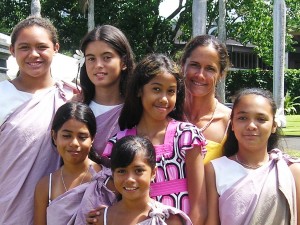
Meeting human needs and preserving local culture are twin core values espoused by our community through the Focus Maui Nui process. Sharon Balidoy, a social worker at Queen Lili`uokalani Children’s Center (QLCC) in Wailuku, is a prime example of a practitioner active on both fronts, making profound contributions to the community.
QLCC is one of ten units statewide founded by the Queen Lili`uokalani Trust; the trust was founded over a century ago. “The work of the Children’s Center is to offer support and counseling services for Hawaiian orphans and their `ohana,” says Balidoy. “Family strengthening services are also provided to children living apart from their biological parents.”
Central to the mission of QLCC is perpetuation of Hawaiian culture and spirituality, and at the Wailuku Center, this means activities such as crafts, music, dance, and site visits to instill a sense of place. Balidoy estimates that QLCC reaches over a thousand children on Maui. “Our staff consists mostly of social workers working in specific communities, and an important aspect of our work is functioning as an effective team”, says Balidoy.
Balidoy is an expert on teamwork – she is a highly-respected competitive outrigger canoe paddler and helped establish Lae`ula O Kai canoe club almost 20 years ago, based at Kanaha Beach Park in Kahului. “Club members have put a lot of work into Park improvements, observes Balidoy. “Participating in community work days and keeping cultural traditions in mind are cornerstones of the club’s activities.”
Over the years, Balidoy has also been intimately involved in hula – she founded the Hālau Hula Alapa`i I Maluuluolele – “another one of my families,” she chuckles. “I studied under my mother, and for my sister and I, hula was a way of life. Now we both teach. The chants and hula are not about competition or seeking perfection. We practice out of respect for our ancestors and to understand their ways and the places they knew and memorialized.” Balidoy leads classes in Lahaina and Paukukalo.
Oct 30, 2010 | Community
 Just a reminder to everyone to cast your vote, either at your polling place or by absentee.
Voting is an essential part of our democratic process, by which you choose the representatives in your government who make decisions that affect you, your family and your community.
For more information, visit the State of Hawai`i Office of Elections website.
Oct 30, 2010 | Sustainability
 It’s lunchtime, and 18 middle- and high-school students are enjoying the sandwiches they made together on the shaded lanai at Hui Malama Learning Center in Wailuku. The discussion is about local sources of food, the benefits of buying Mauigrown produce. It’s agreed—the food is fresher, it tastes better, and it keeps our own farmers in business. There are minimal transportation costs, which also means fewer harmful environmental effects.
This is one element of Hui Malama’s integrated curriculum, Na Ka `Aina Ke Ola – “From the Land There is Life.” “There are practical benefits of the program,” observes Pualani Enos, Executive Director and science teacher. “Hui Malama serves students with unmet needs; our goal is to engage and empower them and provide the tools they need to succeed in the workforce and as individuals. It’s about instilling confidence, teaching responsible citizenship, and providing the skills they need to be effective contributors in society. They learn they can be agents of change.”
Hui Malama’s program on food and its role in learning about sustainability works on many levels. The students learn about agriculture and visit farms, and they also learn about nutrition and eating right. The program teaches shopping for value and keeping to a budget, and the students are learning to cook for themselves. “At our shared meals, it’s an opportunity to work on table manners, social skills, and group conversation,” says Enos.
This year, the sustainability theme is food and agriculture; next year, the theme will be renewable energy, a hot topic on Maui these days and a likely source of rewarding careers. In addition to its current enrollment of 18 students, Hui Malama currently runs an afternoon GED program for 12 students, a number that will expand to 60 in January 2011.
Oct 20, 2010 | Education
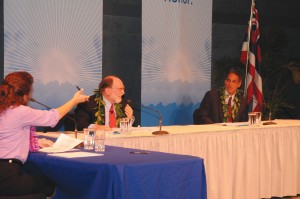
There’ s good news for anyone that missed the live October 6 broadcast of the “Focus 2010: Gubernatorial Conversation” on Akaku Maui Community Television between Lt. Gov. James “ Duke” Aiona and former U.S. Congressman Neil Abercrombie. The forum, held at the Maui Arts and Cultural Center and aired simultaneously on Hawaii Public Radio (HPR) stations, is to be broadcast nationally on C-SPAN, the National Public Affairs cable network. Refer to local listings for exact times and dates for these repeats. In addition, the debate is available online at www.akaku.org; go to Akaku Online and then Video on Demand. It can also be accessed at www.hawaiipublicradio.org.
The 90-minute Forum, which was presented by the Maui Economic Development Board and Hawaii Public Radio, took place in front of a live audience. Kayla Rosenfeld, News Director at HPR, moderated the session and posed questions that reflected the priorities of the Focus Maui Nui vision. The conversation was polite, if occasionally pointed, as the candidates made clear they agreed on defining issues while differing on how state government can respond.
Aiona noted the current administration’s support for STEM (Science, Technology, Engineering and Math) education in Hawaii’s schools and proposed an audit of the Department of Education. Abercrombie spoke in favor of improving education by giving local schools more control and accountability.
Both candidates support development of renewable energy resources, and while Abercrombie proposed a State Energy Authority to support development, Aiona cited progress by the Hawaii Clean Energy Initiative to support renewable energy research and development. Among several other issues, both candidates spoke to the need to deal with the high costs of island transportation, citing high fuel costs as a major factor, and both spoke positively about the importance of spurring science and technology jobs and the potential of astronomy in particular.
View the entire debate on C-SPAN or Akaku, and VOTE in the General Election on Tuesday, Nov. 2.
Oct 13, 2010 | Education
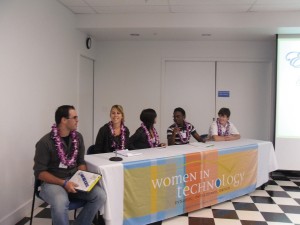
With education identified by the Focus Maui Nui process as a community priority, the Maui Economic Development Board’s recent Education and Graduation Rate conference proved to be both timely and enlightening.
The event, with the theme “E Ulu – Growing Together”, was held in partnership with America’s Promise Alliance, a nonprofit organization based in Washington D.C. dedicated to enhancing high school success. The focus of the conference was to strengthen the Maui Nui’s STEM (Science, Technology, Engineering, and Math) education “pipeline” as a means of improving high school success and increasing graduation rates.
Following an inspirational keynote speech made by Congresswoman Maizie Hirono, a variety of perspectives were shared on challenges, opportunities and a vision for education in Hawaii. Presenters from a wide variety of sectors included a parent, an industry/business professional from a local tech company, a high school principal, elected officials, and a panel of 5 high school students.
These sessions set the direction and tone for the rest of the day. Discussion followed on the most important determining factors for educational excellence: student proficiency, teacher proficiency, school proficiency, and school management. Conference participants then formed smaller groups that focused on each of the four proficiencies in depth.
In addition to exploring means of improving STEM education locally, one of the outcomes of the summit was the creation of an Education Working Group that will continue the work begun at the summit in modeling our education system to better equip our students for STEM careers.
Oct 8, 2010 | Community
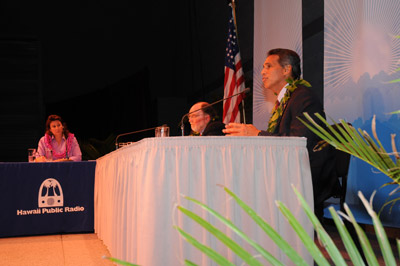
The conversation was polite, if occasionally pointed, as Lt. Gov. James “Duke” Aiona and former U.S. Congressman Neil Abercrombie made clear they agreed on defining issues even as they differed on how state government can respond.
The Republican and Democratic nominees for governor appeared Wednesday, October 6 in “Focus 2010: A Gubernatorial Conversation,” a forum broadcast statewide by Hawaii Public Radio and the state’s community television stations. The forum was sponsored by Maui Economic Development Board and Hawaii Public Radio with support from the Maui Arts & Cultural Center, Akaku: Maui Commuity Television and UH Maui College.
“Focus 2010 was a tremendous success in providing an opportunity for the community on Maui to question the candidates for governor on concerns relevant to the Neighbor Islands,” said MEDB President Jeanne Unemori Skog. “Through the Focus Maui Nui initiative, MEDB is fostering community participation in decisions of land use, water use, education and economic growth. We appreciate the cooperation of these candidates in informing the community of their views.”
For all the contentiousness in campaign advertising in the gubernatorial race, the two partisan candidates demonstrated they could agree on key points. Both said they support the counties’ allocation of the state’s hotel room tax, with Abercrombie adding the historical note that he was in the Legislature when the tax was created to have visitors pay a share of the costs of services that they use. Both spoke on the need to deal with the high costs of interisland transportation but neither offered concrete solutions to make traveling between island less costly. Both cited the cost of fuel as a factor in the costs.
Both spoke positively of the benefits of astronomy in Hawaii in spurring creation of science and technology jobs, citing plans for a 30-meter telescope on Mauna Kea. The Hawaii site was selected by TMT Observatory Corp. for what would be the Earth’s largest optical telescope. Both also recognized the observatories on Mauna Kea and Haleakala raise cultural and environmental concerns. Abercrombie took a positive approach, saying the early Polynesians who first populated Hawaii were students of astronomy, and observatories on Mauna Kea are an extension of that traditional knowledge.
“They arrived here because of their knowledge of the skies and because of their faith in their capacity to understand their world. They could be seen as the first Polynesian astronomers,” he said. While saying he supports space research, Aiona was more cautious, noting that economic developments have impacts on Native Hawaiian culture that need to be aired before a project is initiated.
“When it comes to every project, everyone needs to be at the table,” he said. Both support development of alternative energy resources to reduce Hawaii’s dependence on oil. Aiona cited progress by the Hawaii Clean Energy Initiative to support renewable energy research and development, set up by Gov. Linda Lingle. “We have set a goal of reducing our use of oil by 50 percent by 2018. With the Hawaii Clean Energy Initiative, I think we can do it,” he said.
Abercrombie cited the potential for tapping wind, solar, wave and geothermal energy resources in Hawaii, and cited the success of Pacific Biodiesel in converting waste cooking oil into a transportation fuel. But when Abercrombie referred to his plan for an Energy Authority that would support alternative energy development, Aiona rebutted that it would only create another bureaucracy standing in the way of energy development.
There was convergence and contention in their positions on education as well. Aiona spoke of the Lingle-Aiona administration’s support for STEM education programs in Hawaii’s schools, noting that the state’s efforts to promote Robotics competitions has blossomed. Abercrombie in turn spoke in favor of decentralizing school decision-making to allow individual schools to manage their allocations.
But when Aiona cited the Department of Education’s success in winning a federal Race to the Top award, a $75 million competitive grant to school districts to support plans for increasing student achievement, Abercrombie pointed out it was a federal grant, the kind of government spending that Aiona has been criticizing.
When Aiona said he would order an audit of the Department of Education “so we will know how the money is being spent,” Abercrombie said, “The last thing we need is an audit, the last thing we need is another study.”
The 90-minute forum is being rebroadcast by Akaku on cable Channels 53 and 54 through Oct. 11. A schedule of the broadcasts can be found at www.medb.org/video.
Hawaii Public Radio will broadcast another gubernatorial forum on Oct. 18, with HPR Hawaii correspondent Sherry Bracken as moderator. HPR News Director Kayla Rosenfeld was moderator for Focus 2010.
What are your thoughts on the debate? Please leave a comment below or let us know on Facebook or Twitter.